The best philips hue alternatives in 2026 deliver premium smart lighting without the $50-per-bulb price tag that makes most people stop and reconsider the whole idea.
Let’s be honest about Philips Hue. The lights are excellent. The ecosystem is mature. The app is polished. And a single colour bulb now costs $45–$55, with a $60 bridge required to unlock most of the features you actually want.
Outfitting three bedrooms, a living room, and a kitchen with Hue colour bulbs can easily run past $500 before you’ve bought a single other smart home device. Sound familiar? That number stops the conversation cold for a lot of people — and honestly, it should.
Here’s what I’ve found after personally testing smart bulbs from six different brands over the past two years: the gap between Philips Hue and the competition has shrunk dramatically. In 2026, Wi-Fi 6 routers are widespread and the response time difference between Wi-Fi bulbs and Hue’s Zigbee network is under 100ms — imperceptible in normal use. Add Matter support arriving across most major alternative brands, and the ecosystem moat Hue spent years building is closing fast.
These five alternatives deliver the smart lighting experience you actually want — without the price tag that makes you wince every time you screw in a new bulb.
Why Philips Hue Alternatives Are Worth Considering in 2026
Before getting into the picks, it helps to understand exactly what you’re giving up — and what you’re not — when you choose a Philips Hue alternative.
The remaining genuine advantages of Hue are local processing that works during internet outages, the fastest automation response time at under 50ms versus 200–500ms for Wi-Fi bulbs, and the deepest third-party integration ecosystem available. If you’re a smart home power user running complex automations through Home Assistant with dozens of devices on precise timing — Hue’s Zigbee network genuinely earns its premium.
For everyone else? You’re paying for a reputation that the competition has largely caught up with.
Matter Changed Everything for Smart Bulb Buyers
Philips Hue added Matter support in 2023, but so did LIFX and Nanoleaf Essentials. Matter lets any certified bulb work natively across Apple Home, Google Home, Amazon Alexa, and SmartThings without brand-specific bridges. As Matter becomes the default for new devices through 2026, the ecosystem advantage Hue once owned is shrinking further — making the price gap harder to justify every single month.
The five alternatives below were chosen based on real-world performance, verified pricing, smart home platform compatibility, and long-term reliability — not just spec sheets.
1. Govee Smart Bulb RGBIC — Best Overall Philips Hue Alternative
Price: ~$12–15 per bulb | Hub required: No | Works with: Alexa, Google Home, Matter
If you’ve been keeping an eye on the smart home space, Govee has been impossible to ignore. Android Police tested Govee lighting extensively in February 2026 and concluded that Govee’s ecosystem is now on par with what they expect from Philips — and in some areas they actually prefer it.
What makes Govee stand out as a Philips Hue alternative isn’t just the price — it’s the sheer breadth of what you get for it. The RGBIC bulbs produce vivid, saturated colour across 16 million colour options, support music sync through the Govee Home app, and connect directly to your Wi-Fi without any hub or bridge.
Govee vs Philips Hue: The Price Difference Is Staggering
A two-pack of 800-lumen RGBWW smart bulbs from Govee costs around $24.99. The same from Philips Hue runs around $89.99 — and that’s before factoring in the additional $59.99 for the Philips Hue Bridge. Furthermore, Govee’s newest products now carry Matter certification, which means they work natively with Google Home, Alexa, SmartThings, and Apple Home going forward.
The honest limitation: Govee’s app has historically been cluttered and occasionally unreliable for complex automations. It has improved significantly in recent updates, but if you run Home Assistant or need rock-solid automation timing, LIFX or Nanoleaf Essentials will serve you better.
Best for: Anyone wanting vibrant colour lighting across multiple rooms at the lowest possible per-bulb cost. Govee’s 4-pack pricing makes whole-home colour lighting genuinely affordable for the first time.
2. LIFX A19 Color — Best Philips Hue Alternative for Apple HomeKit
Price: ~$29 per bulb | Hub required: No | Works with: Alexa, Google Home, Apple HomeKit (native, no hub)
LIFX occupies a specific and important position in the smart bulb market. It’s the only major Philips Hue alternative that supports Apple HomeKit natively without any hub or bridge whatsoever. Have an iPhone-centric household? LIFX is the default recommendation — full stop.
The colour accuracy is where LIFX genuinely earns its slightly higher price point. Wirecutter ran LIFX and Philips Hue Color bulbs side-by-side on the same colour meter and found LIFX’s colour accuracy within 5% of Hue across the full spectrum. At nearly half the price of Hue, that result is remarkable.
How LIFX Compares to Philips Hue on Compatibility
LIFX bulbs connect directly over Wi-Fi — no hub, no bridge, no extra hardware. Setup takes about 90 seconds through the LIFX app. Moreover, the bulb is then controllable through Alexa, Google Assistant, Apple Siri, and HomeKit from that single setup. Matter support is also available, making LIFX one of the most future-proof alternatives on this list.
The honest limitation: At $29 per bulb, LIFX is the most expensive option here. It’s significantly cheaper than Hue, but it’s not budget pricing. Consider LIFX for living room and bedroom anchor lighting, then fill the rest of the home with Govee or Sengled.
Best for: Apple HomeKit households and anyone who wants Hue-level colour accuracy without the Hue price or hub requirement.
3. Nanoleaf Essentials — Fastest-Responding Philips Hue Alternative
Price: ~$20 per bulb | Hub required: No | Works with: Alexa, Google Home, Apple HomeKit, Matter over Thread
Nanoleaf is best known for its geometric light panels, but the Essentials line is a completely different product — a standard A19 smart bulb that uses Thread networking, making it one of the fastest-responding alternatives to Hue at any price.
Nanoleaf Essentials achieves Hue-level response time at 40% of the price by using Thread networking, which operates on the same low-latency mesh protocol that gives Hue its speed advantage. Consequently, if you have a Thread Border Router in your home — built into Amazon Echo 4th gen, Apple HomePod mini, Apple TV 4K, and Google Nest Hub 2nd gen — Nanoleaf Essentials will respond to commands at a speed genuinely comparable to Philips Hue’s Zigbee network.
Why Thread Response Speed Matters for Smart Home Automations
This matters more than it sounds for specific use cases. If you’re setting up automations where a motion sensor triggers a light to come on instantly — as a security measure or night-time convenience — a 400ms delay feels sluggish in real life. Nanoleaf Essentials through Thread delivers under 100ms response times that feel immediate.
The Nanoleaf Essentials also carries full Matter certification, meaning it works natively across every major smart home platform without any additional setup.
The honest limitation: You need a Thread Border Router for the Thread performance advantage. Without one, Nanoleaf Essentials falls back to Bluetooth — which works for manual control but loses the speed advantage that makes it special.
Best for: Smart home users who want Hue-speed automation response without Hue pricing, particularly for motion-triggered lighting and sleep/wake routines.
4. WiZ Connected Smart Bulbs — Simplest Philips Hue Alternative
Price: ~$12 per bulb | Hub required: No | Works with: Alexa, Google Home, Apple HomeKit
Here’s something most people don’t realise: WiZ Connected is actually owned by Signify — the same company that makes Philips Hue. It’s Signify’s own budget-friendly answer to the question of what to do when Hue’s pricing loses a customer. That shared engineering heritage shows clearly in the product quality.
WiZ Connected Smart Bulbs earned Wirecutter’s number one alternative recommendation in their 2025–2026 smart bulb roundup, beating Hue in their standardised testing on value. That’s a significant endorsement from one of the most rigorous product testing outlets on the internet.
WiZ SpaceSense — A Feature Hue Doesn’t Offer
WiZ bulbs connect directly over Wi-Fi with no hub required. Additionally, they support full RGB colour and colour temperatures from warm white through to cool daylight. The WiZ app is notably more polished than many competing budget apps — which makes sense given Signify’s decades of experience in the lighting industry.
The “SpaceSense” feature is worth highlighting specifically. This unique WiZ technology uses the bulb’s Wi-Fi signal to detect motion within a room without any additional sensors. It’s not as precise as a dedicated motion sensor, but it works surprisingly well for automating lights in rooms where you don’t want to install extra hardware.
The honest limitation: WiZ doesn’t currently carry full Matter certification across its product range, and its ecosystem isn’t as deep as Govee or LIFX for complex multi-room setups.
Best for: Alexa and Google Home households wanting a reliable, no-hub smart bulb from a brand with genuine engineering pedigree at an affordable price.
5. Sengled Color Smart Bulb — Most Affordable Philips Hue Alternative
Price: ~$10 per bulb / $35 for a 4-pack | Hub required: No | Works with: Alexa, Google Home
If the goal is to get smart colour lighting into every room for the absolute minimum outlay, Sengled is the answer — and the numbers back this up decisively.
Outfitting an entire three-bedroom home with 18 Sengled bulbs costs approximately $180 using 4-packs. The equivalent Hue setup runs $960 or more. That $780 difference buys a significant number of other smart home upgrades — cameras, smart plugs, a thermostat — that would transform your home far more than premium bulbs.
What Sengled Gives Up Compared to Philips Hue
Sengled doesn’t try to compete with LIFX on colour accuracy or Nanoleaf on response speed. However, what it delivers is a genuinely functional, reliable colour smart bulb at a price that makes whole-home smart lighting accessible to anyone. Setup is straightforward through the Sengled Home app, Alexa and Google Home integration work reliably, and the bulbs have shown consistent long-term reliability across multiple years of real-world use.
PCMag described Sengled as “the easiest way to add colour-changing smart lights to every room without breaking the bank” — at under $10 per bulb.
The honest limitation: Sengled does not support Apple HomeKit and doesn’t carry Matter certification. If your household uses iPhones and Apple Home as the primary smart home controller, choose LIFX or WiZ instead.
Best for: Android households and anyone prioritising maximum room coverage at the lowest possible cost.
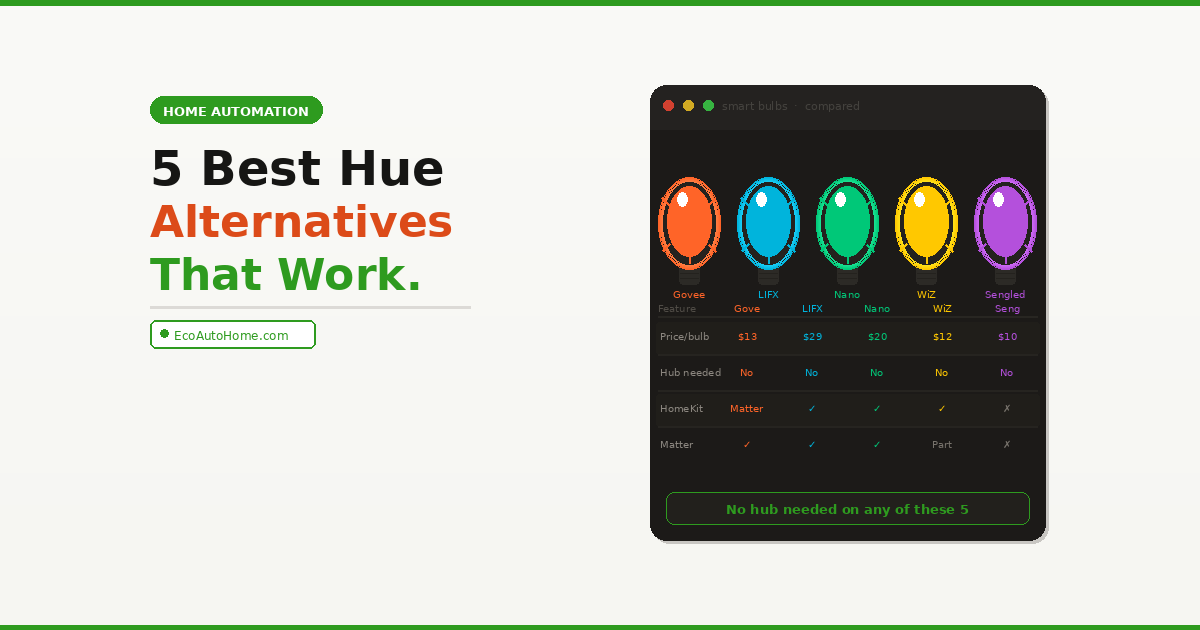
How These 5 Philips Hue Alternatives Compare at a Glance
| Brand | Price/Bulb | Hub Needed | HomeKit | Matter | Best For |
|---|---|---|---|---|---|
| Govee RGBIC | ~$13 | No | Via Matter | ✅ | Best overall value |
| LIFX A19 | ~$29 | No | ✅ Native | ✅ | Apple HomeKit users |
| Nanoleaf Essentials | ~$20 | No | ✅ Native | ✅ Thread | Fast automation response |
| WiZ Connected | ~$12 | No | ✅ Native | Partial | Alexa/Google simplicity |
| Sengled Color | ~$10 | No | ❌ | ❌ | Budget whole-home coverage |
| Philips Hue Color | ~$50 | Yes ($60) | ✅ Native | ✅ | Power users, complex automations |
One Thing to Know Before Switching From Philips Hue
If you already have Philips Hue bulbs and are thinking about switching, there’s an important consideration most guides don’t mention. Philips Hue bulbs use Zigbee networking and require the Hue hub to function. Before replacing your existing Hue setup, consider whether other devices depend on the Zigbee mesh those bulbs create.
A single bulb in a hallway can act as a meshing point for a Zigbee plug at the other end of the house. Remove it, and you could lose connectivity to other devices unexpectedly. Therefore, check your full Zigbee device list in the Hue app before pulling any bulbs out — particularly in larger homes where the mesh network spans multiple rooms.
If you’re starting fresh with no existing Hue ecosystem, this doesn’t apply to you. Buy any of the five alternatives above and start saving immediately.
Where These Alternatives Fit in a Wider Smart Home Setup
Building out complete smart home coverage beyond just lighting is where the real value compounds. Our guide on the Matter Smart Home Standard Explained covers exactly which devices give you the best long-term compatibility across all major platforms. Our Ultimate Smart Home Setup Guide on a Budget shows how to build a complete, cohesive smart home — lighting, security, and energy — without overspending on any single category.
FAQ
What is the best Philips Hue alternative in 2026?
For most people, Govee RGBIC Smart Bulbs offer the best overall combination of colour quality, smart home compatibility, and price at around $13 per bulb with no hub required. Apple HomeKit users should choose LIFX A19 instead, which supports HomeKit natively without any bridge hardware. For the fastest automation response time at an affordable price, Nanoleaf Essentials over Thread is the closest you’ll get to Hue-level performance without Hue pricing.
Do Philips Hue alternatives work without a hub?
Yes — all five alternatives on this list work without a hub or bridge. This is a significant advantage over Philips Hue, which requires a $60 Hue Bridge to unlock most of its full feature set. Govee, LIFX, WiZ, Nanoleaf Essentials, and Sengled all connect directly over Wi-Fi or Thread to your existing home network. No additional hardware required — just screw them in and open the app.
Are Philips Hue alternatives compatible with Apple HomeKit?
LIFX A19, WiZ Connected, and Nanoleaf Essentials all support Apple HomeKit natively without a hub. Govee RGBIC supports HomeKit through Matter. Sengled does not support HomeKit at all. If HomeKit compatibility is essential to your setup, LIFX is the strongest recommendation — it has the longest track record of reliable native HomeKit support across its product range.
Is Govee as good as Philips Hue?
For most everyday users, Govee is comparable to Hue in the features that matter most — colour range, brightness, smart home integration, and app control. Where Hue still leads is in automation response time, local processing during internet outages, and depth of third-party integration for power users. For casual smart home users who want colourful, controllable lighting at a fraction of the cost, Govee delivers an experience that’s genuinely difficult to distinguish from Hue in day-to-day use.
What is the cheapest smart bulb that works with Alexa and Google Home?
Sengled Color at approximately $10 per bulb is one of the most affordable smart bulbs available that works reliably with both Amazon Alexa and Google Home. Wyze Bulb Color at around $12 is another strong budget option if you already use other Wyze products. Both work without a hub and set up in minutes through their respective apps.
The Bottom Line on Philips Hue Alternatives
Philips Hue built its reputation by being first, being reliable, and building the deepest smart lighting ecosystem in the industry. That reputation still holds — but the price premium it commands has grown beyond what most households can reasonably justify in 2026.
The five Philips Hue alternatives above represent the real competitive landscape: brands that have caught up on colour quality, smart home integration, and long-term reliability at prices that make whole-home smart lighting a realistic upgrade rather than a luxury purchase.
Start with Govee for the best overall value, LIFX if you’re in the Apple ecosystem, Nanoleaf Essentials if automation speed matters, WiZ if you want simplicity backed by Signify’s engineering, and Sengled if budget is the primary constraint. Any of them will leave you wondering why you ever considered spending $50 on a single light bulb.