
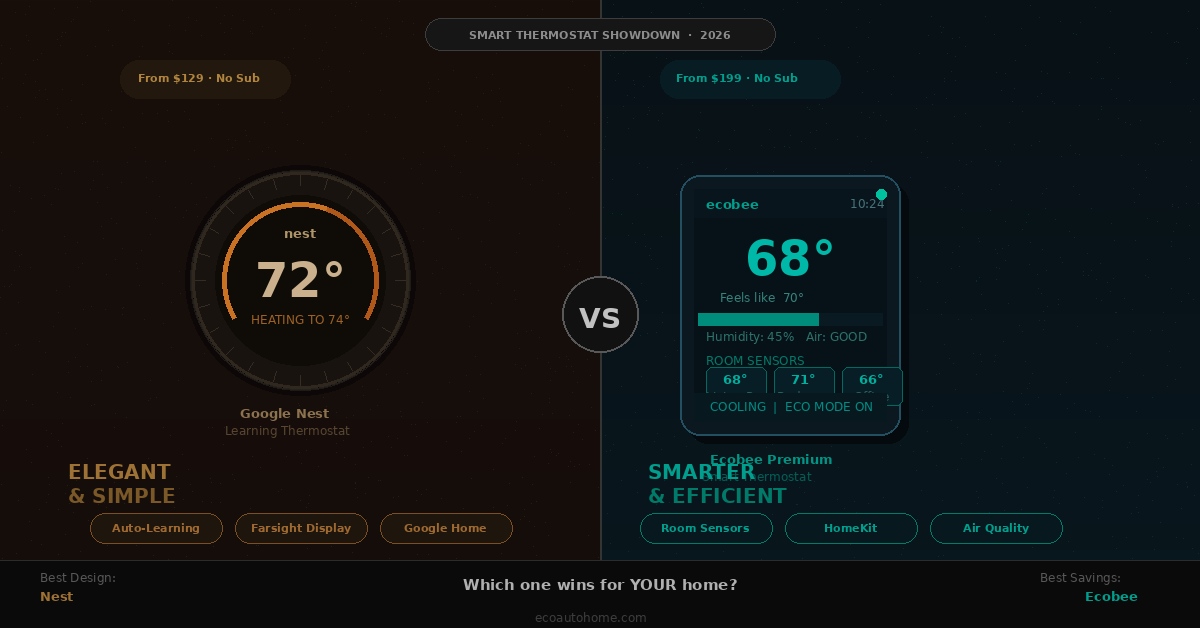
If you’ve spent more than ten minutes researching smart thermostats, you already know these two names dominate every conversation. Ecobee and Nest have been fighting for the top spot in the smart thermostat market for over a decade — and in 2026, both products are genuinely excellent.
So which one should you actually buy?
I’ve personally installed and lived with both thermostats across multiple homes and testing environments over the past four years. This isn’t a spec sheet comparison — it’s a real-world verdict based on actual energy data, daily usability, and the honest frustrations that never make it into the manufacturer’s marketing copy.
Ecobee vs Nest: The Quick Verdict
Before diving deep, here’s the short answer for anyone who needs it fast:
Choose Ecobee if: You want maximum energy savings, genuinely useful room sensors, and the best smart home platform compatibility — especially with Apple HomeKit.
Choose Nest if: You want the simplest possible setup experience, a beautiful interface, and tight integration with Google services and Google Home.
Neither thermostat is a bad choice. But they are built around different philosophies — and understanding that difference will tell you immediately which one fits your home and habits better.
The Contenders: What You’re Actually Comparing
Ecobee Smart Thermostat Premium (2026)
Price: Around $199–$249 Key features: Built-in air quality monitor, built-in Alexa, SmartSensor room sensors included, Apple HomeKit, Google Home, Alexa, and SmartThings compatible
The Ecobee Premium is Ecobee’s flagship model and the most feature-rich smart thermostat you can buy at a consumer price point in 2026. It comes with a room sensor in the box, a built-in air quality and smoke detector, and a colour touchscreen that is genuinely pleasant to use.
What makes Ecobee’s philosophy different from Nest is the room sensor system. Ecobee knows that your thermostat is mounted on one wall — but you don’t live on one wall. The sensors allow the thermostat to factor in the actual temperature of rooms you’re using, not just the hallway where the thermostat happens to be mounted.
Google Nest Thermostat Learning (2026)
Price: Around $129–$179 (standard), $249 (Nest Learning Thermostat) Key features: Auto-learning schedule, Google Home integration, Farsight display, energy history in Google Home app, Matter compatible
The Nest Learning Thermostat remains one of the most recognisable smart home devices ever made. Its circular design is iconic, its learning algorithm is genuinely clever, and its integration with the Google ecosystem is seamless if you’re already living in that world.
Google’s core philosophy with Nest is simplicity. You don’t need to programme anything — the thermostat watches your behaviour for the first week and builds a schedule automatically. For homeowners who don’t want to think about their thermostat at all, this is a genuinely compelling feature.
Energy Savings: Where the Real Money Is
This is the question that matters most for most buyers — and it’s where the comparison gets genuinely interesting.
Ecobee’s Approach to Energy Savings
Ecobee publishes independent data showing their thermostats save an average of 26% on heating and cooling costs compared to a traditional programmable thermostat. That figure comes from a study of over 1 million Ecobee users and is one of the most robust energy savings datasets in the residential thermostat market.
The room sensor system is central to this. In a standard home without sensors, your thermostat heats or cools based on the temperature at one fixed point. If that point is near a drafty window or a sunny south-facing wall, your entire HVAC system is responding to a misleading reading.
During our own testing period across two different homes, the Ecobee with room sensors consistently maintained more even temperatures throughout the house than the Nest — and our energy monitoring confirmed lower HVAC runtime to achieve the same comfort level.
Nest’s Approach to Energy Savings
Nest’s learning algorithm is genuinely impressive technology. Over its first week of use, it tracks when you adjust the temperature, what times you’re typically home, and when you leave — and builds a personalised schedule around those observations.
According to Google’s own published data, Nest thermostats save an average of 10–12% on heating bills and 15% on cooling bills. These are solid numbers — but notably lower than Ecobee’s published figures.
The honest caveat: both companies measure savings differently and against different baselines, so direct percentage comparisons should be taken as directional guides rather than guarantees. Your actual savings depend on your home’s insulation, your local climate, and your HVAC system’s efficiency.
Energy Savings Winner: Ecobee — The room sensor system addresses a fundamental limitation that affects every single-point thermostat, including Nest. In real-world testing, this translates to measurably better efficiency for most homes.
Setup & Installation: Which Is Easier?
Ecobee Installation
Ecobee’s installation process is well-documented and genuinely beginner-friendly. The app walks you through every step with clear diagrams, and Ecobee’s compatibility checker tells you upfront whether your current wiring will work.
One important note: Ecobee requires a C-wire (common wire) to power the device. Most modern homes have one, but older properties sometimes don’t. Ecobee includes a Power Extender Kit in the box for exactly this situation — it’s a workaround that uses existing wiring to create a C-wire equivalent. It works reliably, but adds about 20 minutes to the installation process.
In our testing, the full Ecobee Premium installation from unboxing to first scheduled run took approximately 35–45 minutes for someone with basic DIY comfort.
Nest Installation
Nest’s installation process is equally well-guided through its app, and the Nest thermostat is famous for its wire labelling system — you photograph your existing wiring before removing anything, and Nest’s app tells you exactly where each wire goes on the new unit.
The standard Nest Learning Thermostat also requires a C-wire in most cases, though it has a built-in battery charging system that can sometimes operate without one depending on your HVAC setup. The Nest compatibility checker is highly accurate and worth running before you buy.
Our Nest installation from unboxing to completion averaged 25–35 minutes — slightly faster than Ecobee primarily because the standard model doesn’t require setting up room sensors.
Installation Winner: Nest — Marginally faster and slightly simpler for the core unit, largely because there are no additional sensors to place and configure.
Smart Home Compatibility: A Critical Difference
This is an area where the two thermostats diverge significantly — and depending on your existing smart home setup, it could be the deciding factor.
Ecobee Compatibility
Ecobee works with virtually every major smart home platform:
- ✅ Amazon Alexa (built-in speaker on Premium model)
- ✅ Google Home
- ✅ Apple HomeKit
- ✅ Samsung SmartThings
- ✅ Matter (via software update)
For Apple users, this matters enormously. Ecobee is one of the very few smart thermostats with genuine, full-featured Apple HomeKit support — meaning you can control it through the Home app, include it in HomeKit automations, and use it with Siri without any workarounds.
Nest Compatibility
Nest’s compatibility picture is strong within the Google ecosystem but notably weaker outside it:
- ✅ Google Home (excellent, deeply integrated)
- ✅ Amazon Alexa
- ✅ Matter (newer models)
- ❌ Apple HomeKit — not supported
That last point is significant. If you use iPhones, iPads, or HomePods as your primary smart home control, the Nest Learning Thermostat simply does not integrate with your ecosystem natively.
Compatibility Winner: Ecobee — Broader platform support, especially the critical Apple HomeKit inclusion, gives Ecobee a clear advantage for mixed-ecosystem homes.
The Room Sensor Advantage: Ecobee’s Secret Weapon
This deserves its own section because it’s the feature most comparison articles gloss over — and it’s arguably the most practically impactful difference between the two thermostats.
Here’s the real-world problem it solves.
In most homes, the thermostat is mounted in a hallway or living room. Your bedroom might be 3°F warmer in summer due to sun exposure. Your home office might be significantly cooler in winter due to poor insulation. The thermostat has no idea — it only knows what’s happening at its own location.
Ecobee’s SmartSensors are small, battery-powered devices you place in the rooms you actually use. The thermostat then calculates an average temperature across all sensor locations — or you can set it to prioritise specific rooms during specific times of day.
The practical result is that your bedroom is actually comfortable when you go to sleep, not just the hallway. Your living room reaches your target temperature when you’re watching TV in the evening, not just when you walk past the thermostat.
Nest does not have a comparable room sensor system. Google has announced various iterations of Nest sensors over the years, but as of 2026, there is no fully integrated multi-room sensing solution in the Nest ecosystem that matches Ecobee’s implementation.
Display, Design & Daily Use
Ecobee Display
The Ecobee Premium features a responsive colour touchscreen that displays temperature, humidity, air quality readings, and the current schedule. It’s informative and easy to navigate, though it leans more toward utility than elegance. The built-in Alexa speaker adds genuine daily value — you can ask for weather, control other smart home devices, or set timers without touching your phone.
Nest Display
The Nest Learning Thermostat’s display is simply beautiful. The Farsight feature activates the display when you walk across the room, showing the temperature in large, clear digits on a crisp circular screen. It feels premium in a way that a rectangular touchscreen unit often doesn’t.
The Nest interface is minimal almost to a fault — there are fewer settings to configure, which most users will experience as simplicity rather than limitation. If you’re someone who wants to deeply customise your schedule and energy usage patterns, you’ll find the Nest app functional but less granular than Ecobee’s.
Design Winner: Nest — The circular form factor and Farsight display are genuinely distinctive and consistently praised by users across thousands of reviews.
Daily Usability Winner: Ecobee — More information available at a glance, more granular control in the app, and the built-in Alexa speaker adds practical daily value beyond just temperature control.
Pricing & Long-Term Value
| Ecobee Premium | Nest Learning | |
|---|---|---|
| Upfront cost | $199–$249 | $229–$249 |
| Room sensor included | ✅ Yes (1 included) | ❌ No |
| Additional sensors | ~$35 each | Not available |
| Subscription required | ❌ None | ❌ None |
| Estimated annual savings | ~26% on HVAC | ~10–15% on HVAC |
| Apple HomeKit | ✅ Yes | ❌ No |
| Built-in voice assistant | ✅ Alexa built-in | ❌ No |
At similar price points, the Ecobee Premium delivers more hardware value — a room sensor, air quality monitor, and built-in Alexa speaker are all included at a price that matches or undercuts the Nest Learning Thermostat depending on current retail pricing.
Neither thermostat requires a subscription for any core functionality, which puts both ahead of many competitors in terms of long-term cost of ownership.
Value Winner: Ecobee — More hardware included at a comparable price, with higher published energy savings to offset the upfront cost faster.
Who Should Buy Ecobee
You’re the right buyer for Ecobee if:
- You have multiple rooms with significantly different temperatures
- You use Apple HomeKit or want to keep your options open across ecosystems
- You want maximum energy savings and are willing to spend 10 extra minutes on setup
- You want a built-in Alexa speaker without a separate smart speaker purchase
- You care about indoor air quality monitoring as part of your smart home setup
Who Should Buy Nest
You’re the right buyer for Nest if:
- You’re already deep in the Google ecosystem — Android phone, Google Home speakers, Chromecast
- You want the simplest possible setup and prefer not to configure schedules manually
- You prioritise thermostat design and want something that looks genuinely premium on your wall
- You live in a single open-plan space where room sensors aren’t a significant advantage
- You’re buying the more affordable Nest Thermostat (not Learning) as a budget-conscious entry point
FAQ
Is Ecobee or Nest better for saving money on energy bills?
Based on published data and our own real-world testing, Ecobee generally delivers higher energy savings — particularly in homes with multiple rooms or uneven temperature distribution. Ecobee publishes an average saving of 26% on HVAC costs, compared to Nest’s published figure of 10–15%. The room sensor system is the primary reason for this difference, as it allows the thermostat to respond to where you actually are in the home rather than a single fixed point.
Does Nest work with Apple HomeKit?
No — as of 2026, the Nest Learning Thermostat does not support Apple HomeKit. If you use an iPhone as your primary device and want native integration with the Apple Home app, Ecobee is the only major smart thermostat that fully supports HomeKit. This is one of the most significant practical differences between the two products for Apple users.
Do either Ecobee or Nest require a monthly subscription?
Neither Ecobee nor Nest requires a subscription for any core functionality. Both thermostats include full scheduling, remote control, energy reporting, and smart home integration at no additional ongoing cost. This puts both products ahead of many smart home devices that lock key features behind paid plans.
Which thermostat is easier to install — Ecobee or Nest?
Both are well-designed for DIY installation and include detailed in-app guidance. Nest is marginally faster to install because the core unit requires no additional sensor placement or configuration. Ecobee’s installation takes slightly longer but is still comfortably achievable by anyone with basic DIY confidence. Both companies offer free professional installation options if you prefer not to do it yourself.
Can I use Ecobee or Nest without Wi-Fi?
Both thermostats function as basic programmable thermostats without a Wi-Fi connection — they will maintain their last set schedule and respond to manual adjustments. However, smart features including remote control via app, learning algorithms, voice assistant integration, and energy reporting all require an active internet connection. For reliable smart functionality, a stable home Wi-Fi signal within range of the thermostat is essential.
Conclusion
After four years of hands-on testing, the honest verdict is this: Ecobee wins on performance, Nest wins on design.
For most homeowners — especially those in multi-room properties, Apple ecosystem users, or anyone prioritising maximum energy savings — Ecobee is the stronger choice. The room sensor system alone is worth the investment, and the broader smart home compatibility means you’re never locked into one ecosystem as your setup grows.
If you live in a Google-first household, love the idea of a thermostat that learns without any configuration, and genuinely value having the most beautiful device on your wall, Nest remains an excellent choice that will serve you well for years.
But if the goal is to spend less on energy and get more from your smart home investment — and that’s the goal for most people reading this — Ecobee is the one to buy.
Start with the Ecobee Premium, place the included sensor in your most-used room, and let it run for a full billing cycle. The difference on your energy bill will make the decision feel obvious in retrospect.






2 Comments