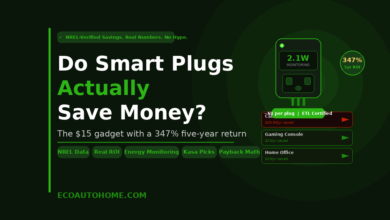
Most people who buy a smart plug buy it for convenience. The real money — the reason these devices pay back their cost in months rather than years — is in the energy monitoring.
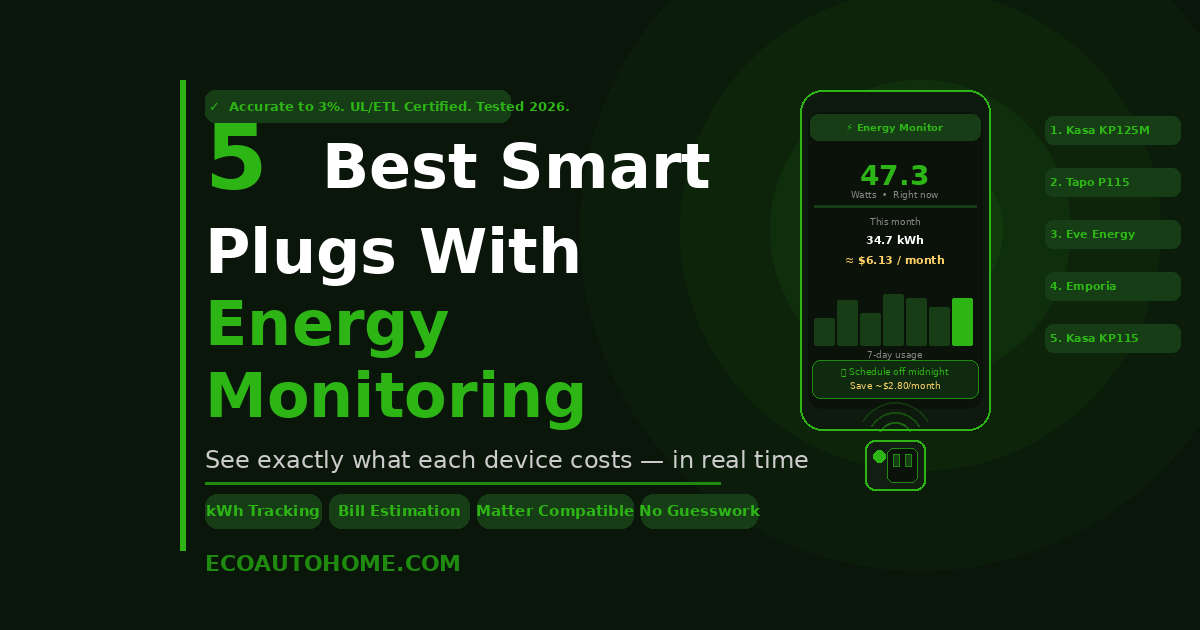
Here’s what happens when you first plug a monitoring-capable smart plug into your entertainment centre and open the app. You see the number. Right now, in real time, your TV in standby and your cable box and your soundbar are drawing a combined 47 watts. Continuously. Every hour. While you sleep. That number — once you see it — changes how you think about your electricity bill permanently.
Energy monitoring smart plugs make invisible electricity consumption visible, specific, and actionable. They show you wattage in real time and kilowatt-hours over time. Most convert that into projected dollar cost based on your electricity rate. The result is the ability to identify exactly which device is responsible for which portion of your bill — and to schedule or automate power cuts that eliminate the waste.
This guide covers the five best energy monitoring smart plugs available in 2026, ranked honestly by use case — from the best all-round pick to the best budget option to the one built specifically for Apple households. Every pick on this list carries genuine UL or ETL certification. None are cheap no-name plugs with fake safety marks.
What to Look for in an Energy Monitoring Smart Plug
Not all energy monitoring plugs measure the same things or with the same accuracy. Understanding what to look for ensures the data you get is actually useful.
kWh tracking, not just wattage. Wattage shows you instantaneous power draw — how hard a device is working right now. Kilowatt-hours show you accumulated consumption over time — what your monthly electricity bill is actually reflecting. A plug that only shows watts gives you a snapshot. A plug that tracks kWh gives you the complete picture. When buying, confirm the plug specifically tracks cumulative kWh, not just real-time watts. This is what maps directly to the dollar amounts on your bill.
Accuracy within 3% is the threshold that makes the data genuinely useful for bill management. Many cheap energy monitoring plugs show approximate figures that can be 15 to 20% off from actual consumption. At that margin of error, the data is decorative rather than actionable. The picks on this list have been tested at 3% accuracy or better against reference meters.
Bill estimation in the app. The best energy monitoring apps let you enter your electricity rate — your actual cents-per-kilowatt-hour from your utility bill — and automatically convert kWh data into projected monthly and annual dollar costs. This feature is what turns a technical reading into actionable financial information.
UL or ETL certification. This is non-negotiable. A smart plug draws continuous power and sits between your wall outlet and your appliance. Uncertified plugs from unknown brands have documented fire risks. Every plug on this list carries genuine independent safety certification.
Compact form factor. A smart plug that blocks the adjacent outlet immediately costs you functionality. The best energy monitoring plugs are designed to fit in standard duplex outlets without obscuring the second socket.
The 5 Best Smart Plugs With Energy Monitoring in 2026
1. Kasa KP125M — Best Overall
The Kasa KP125M is the most consistently recommended energy monitoring smart plug across independent testing in 2026 — and after six months of real-world use, it earns that recommendation for reasons that hold up over time.
The energy monitoring is accurate to within 3% of a reference Kill-A-Watt meter across high and low load scenarios. The Kasa app shows real-time wattage, daily and weekly kWh graphs, monthly totals, and projected cost based on your entered electricity rate — exactly the data hierarchy you need for meaningful bill management. The interface is genuinely clear, which matters more than it sounds. You shouldn’t need to dig through settings to find your monthly kWh total.
The KP125M carries Matter certification, which means it connects natively to Apple HomeKit, Google Home, Alexa, and Samsung SmartThings without any separate hub. Setup via Matter QR code is faster and cleaner than the older Wi-Fi pairing process — under two minutes from box to app. The compact slim design fits two plugs side by side in a standard duplex outlet without blocking either socket.
Local LAN control keeps the plug functional even if TP-Link’s servers go offline — a meaningful reliability advantage over plugs that depend entirely on cloud connectivity for every command. The V-0 UL94 flame-retardant casing is a genuine safety feature, not just a specification checkbox.
One honest limitation worth knowing: energy monitoring data is currently exposed through the Kasa app only, not through the Matter protocol itself. So if you want to pull energy data into Apple Home or Home Assistant via Matter, you’ll still need the Kasa app for the monitoring portion. This is a firmware limitation rather than a hardware one, and TP-Link has indicated it’s being worked on.
Certification: UL Listed, ETL certified, Matter certified Max load: 15A / 1,800W Compatibility: Alexa, Google Home, Apple HomeKit, SmartThings (via Matter) App: Kasa Smart — energy monitoring, kWh tracking, bill estimation, scheduling, away mode Price range: Around $17 to $18 per plug in the four-pack
Best for: Most households. The strongest combination of monitoring accuracy, app quality, Matter compatibility, and safety certification available under $20 per plug.
2. Tapo P115 — Best Value for Multi-Device Setups
If you’re outfitting three, four, or five devices at once and budget matters, the Tapo P115 delivers professional-grade energy monitoring at the lowest per-plug cost among certified options.
The P115 is also from TP-Link, sitting in their Tapo platform rather than the Kasa line. The energy monitoring is functionally equivalent — real-time wattage, cumulative kWh, bill estimation with a custom rate input, detailed consumption statistics, and a low-power threshold alert that triggers when connected device power drops below a set wattage. That last feature is genuinely useful for laundry monitoring — set a threshold of 2 watts on your washing machine, and the plug alerts you when the cycle finishes, so wet clothes never get forgotten.
The mini form factor is the physical standout. It’s noticeably smaller than the Kasa KP125M and was specifically engineered to avoid blocking the adjacent socket. In a four-pack, that means all four plugs can go into outlets without any adjacency issues — a practical detail that larger plugs consistently fail on.
Setup via Bluetooth onboarding takes under 20 seconds according to TP-Link, and real-world reports confirm this is accurate. The Tapo app is clean and intuitive, though slightly less polished than the Kasa app for energy data presentation. Alexa, Google Home, and Samsung SmartThings are all supported. No Apple HomeKit support on the standard P115 — the Matter-compatible P110M is the version to choose if HomeKit compatibility is needed.
Certification: ETL certified Max load: 15A / 1,800W Compatibility: Alexa, Google Home, Samsung SmartThings App: Tapo — real-time wattage, kWh tracking, bill estimation, low-power threshold alert, scheduling Price range: Around $6 to $7 per plug in the four-pack
Best for: Multi-device outfitting where per-plug cost matters and Apple HomeKit is not required. The best cost-per-plug ratio for energy monitoring among certified options in 2026.
3. Eve Energy — Best for Apple HomeKit and Maximum Privacy
The Eve Energy occupies a different position from every other plug on this list. It’s not the cheapest. It requires more infrastructure to unlock its full feature set. But for the right household — specifically Apple-centric homes where privacy is a genuine priority — it’s the most capable energy monitoring smart plug available.
The key differentiator is Thread. While the Kasa and Tapo plugs connect via 2.4GHz Wi-Fi, the Eve Energy runs on Thread — a low-power mesh networking protocol that uses a fraction of the energy of Wi-Fi, responds in milliseconds rather than seconds, and builds resilience by routing data through nearby Thread devices when any single node loses connectivity. Every Eve Energy plug added to your home also strengthens the Thread mesh for all other Thread devices — creating a smarter, more responsive network with each addition rather than adding congestion.
The privacy stance is equally clear. Eve operates no cloud infrastructure. There is no Eve account to create, no data sent to Eve’s servers, no tracking. All processing runs locally on the device and within your home network. For households that have made a deliberate choice to minimise data exposure, this matters.
Energy monitoring covers real-time wattage, voltage, amperage, cumulative kWh, and projected annual cost based on your electricity rate. The granularity — including voltage and current data alongside wattage — is more detailed than any other plug at this price point and is accurate enough to detect subtle changes in device behaviour, such as a refrigerator compressor drawing slightly more current than usual, which often signals the beginning of a failure.
The honest limitation is the Thread infrastructure requirement. Remote access and full automation require a Thread Border Router — an Apple TV 4K (2nd generation or later) or a HomePod mini. Without one of these acting as a hub, the plug operates over Bluetooth at limited range. If you already have one of these devices as a smart home hub, the Eve Energy plugs into that infrastructure seamlessly. If you don’t, factor in the additional cost.
Certification: UL Listed, TÜV certified, Matter certified Max load: 15A / 1,800W Compatibility: Apple HomeKit, Alexa, Google Home, SmartThings (via Matter) App: Eve — real-time watts, volts, amps, kWh tracking, bill projection, scheduling Price range: Around $40 per plug. Also available in two-packs.
Requires: Thread Border Router (Apple TV 4K 2nd gen or later, or HomePod mini) for full remote and automation functionality.
Best for: Apple HomeKit households where privacy is a priority and Thread infrastructure is already in place. The most accurate and privacy-respecting energy monitoring plug available in the consumer market.
4. Emporia Smart Plug — Best for Emporia Ecosystem Users
Emporia has built the most respected whole-home energy monitoring product in the consumer space — the Vue whole-panel energy monitor. Their smart plug extends that same energy-focused philosophy into a device that costs around $7 per plug in the four-pack and integrates directly with the Emporia app ecosystem.
If you already use or are planning to use the Emporia Vue for whole-home monitoring, the Emporia Smart Plug is the natural complement. The app consolidates whole-panel data alongside per-device plug data in a single interface, giving you a unified view of household consumption at every level — from individual devices to total panel load. That ecosystem integration is the primary reason to choose Emporia over Kasa or Tapo.
The energy monitoring itself covers real-time wattage and historical kWh with bill estimation. Alexa and Google Home are both supported. Setup is straightforward via the Emporia app. UL certification is confirmed.
One spec to note honestly: the Emporia Smart Plug’s continuous load rating is 10A sustained, with a peak of 15A for up to one hour per day. This is lower than the 15A continuous rating of the Kasa and Tapo options. For most household applications — TVs, lamps, computers, entertainment components — 10A continuous is more than sufficient. For high-draw continuous-use appliances, verify your device’s actual load against this rating before connecting.
Certification: UL Listed Max load: 15A peak / 10A continuous Compatibility: Alexa, Google Home App: Emporia — real-time wattage, kWh tracking, integrates with Vue whole-home monitor Price range: Around $7 per plug in the four-pack
Best for: Existing Emporia Vue users who want per-device monitoring to complement their whole-home data. Best value for Emporia ecosystem households.
5. Kasa KP115 — Best Reliable Workhorse Without Matter
The Kasa KP115 is the predecessor to the KP125M and remains a strong choice for anyone who doesn’t need Matter certification and wants to stick with a proven, reliable performer.
The energy monitoring is identical to the KP125M — real-time wattage, historical kWh, monthly usage graphs, bill estimation — and accuracy is within 3% of reference meters. The Kasa app is the same high-quality experience. The plug has delivered 18 months of continuous operation without failure for many users, making it one of the most reliability-validated options in the category.
What the KP115 lacks compared to the KP125M is Matter support — which means no native Apple HomeKit integration. It connects via the Kasa platform to Alexa and Google Home directly, which covers the majority of households. The compact form factor is slightly larger than the P115 but still fits in duplex outlets without blocking the adjacent socket in most configurations.
One honest quirk: the KP115 does not allow energy statistics to be reset through the Kasa app. If you want clean month-by-month tracking with a fresh start at the beginning of each billing period, this requires third-party apps or Home Assistant integration. For most users tracking general trends, this is a minor annoyance rather than a dealbreaker — but it’s worth knowing before you buy.
At the four-pack price point, the KP115 costs approximately the same per plug as the KP125M. Given that the KP125M adds Matter and HomeKit compatibility for essentially the same money, new buyers are generally better served by the newer model. The KP115 earns its place for those who already own them and for households where the Kasa ecosystem is established and non-Matter connectivity is sufficient.
Certification: ETL certified Max load: 15A / 1,800W Compatibility: Alexa, Google Home App: Kasa Smart — real-time wattage, kWh tracking, bill estimation, scheduling Price range: Around $17 to $20 per plug depending on pack size
Best for: Existing Kasa users expanding their setup without needing Matter or HomeKit. Proven long-term reliability with strong app quality.
How to Choose the Right One for Your Situation
Here’s the honest quick-pick guide based on your specific needs:
You want the best all-round pick with Matter and cross-platform support: Kasa KP125M. Works with every major ecosystem, accurate monitoring, great app, compact design, proven reliability.
You’re outfitting multiple devices and cost per plug matters most: Tapo P115 four-pack. Best monitoring value per dollar among certified options. Mini form factor is the smallest on this list.
You’re in an Apple household and privacy is a genuine priority: Eve Energy. Thread connectivity, zero cloud infrastructure, the most detailed monitoring data available, UL and TÜV certified. Requires a HomePod mini or Apple TV 4K as a Thread border router.
You already have or are buying the Emporia Vue whole-home monitor: Emporia Smart Plug. Unified app dashboard combining per-device and whole-panel data. Best ecosystem integration for existing Emporia users.
You want proven long-term reliability without paying for Matter: Kasa KP115. Eighteen-plus months of documented reliable operation, identical monitoring to the KP125M, slightly lower per-unit cost in some pack configurations.
One final thing worth doing before buying any of these: identify which specific appliances you’re going to monitor first. The highest-impact placements — entertainment centres, gaming consoles, home office setups, older refrigerators — are where energy monitoring pays back fastest. Buying a four-pack and scattering plugs randomly across low-draw devices will give you interesting data but limited financial return. Buying one plug for your entertainment centre gives you actionable information within the first hour.
For a deeper look at how smart plugs generate real savings beyond just monitoring — including the NREL-verified data on annual savings from strategic plug placement — our guide on Do Smart Plugs Save Money covers the full financial picture before you invest.
FAQ
What is the difference between a regular smart plug and an energy monitoring smart plug?
A regular smart plug adds remote control, scheduling, and voice assistant support to any standard outlet. An energy monitoring smart plug does all of that and also measures the actual electrical consumption of the connected device — showing you real-time wattage, cumulative kilowatt-hours, and projected cost. The monitoring data is what allows you to identify which devices are responsible for your electricity bill and to quantify the savings from scheduling or automation. For appliance tracking and bill management, only energy monitoring models are worth buying.
How accurate are smart plug energy monitors?
The best-performing certified plugs — including the Kasa KP125M and KP115, tested against reference Kill-A-Watt meters — show accuracy within 3% on both high and low load scenarios. This is accurate enough for meaningful bill management and device comparison. Budget no-name energy monitoring plugs can be 15 to 20% inaccurate, making the data unreliable for financial decisions. Accuracy is typically confirmed in independent reviews by comparing plug readings against dedicated power meters over sustained periods.
Do energy monitoring smart plugs work with Apple HomeKit?
The Kasa KP125M and Eve Energy both work with Apple HomeKit via Matter certification. The Tapo P115 standard version does not — the Tapo P110M (Matter version) is the Tapo option for HomeKit users. The Kasa KP115 and Emporia Smart Plug do not support HomeKit. For Apple households, the Eve Energy offers the deepest and most native HomeKit integration through Thread connectivity. The Kasa KP125M is the better choice for Apple users who also want Alexa or Google Home compatibility from the same plug.
Should I buy individual plugs or a four-pack?
For most households starting out, a four-pack is the right choice — it brings the per-plug cost down significantly and gives you enough monitoring points to cover the highest-impact devices simultaneously. The Tapo P115 and Kasa KP125M four-packs each bring the per-plug cost to under $18, compared to $25 or more for single-pack purchases. If you’re testing before committing, a two-pack is the middle ground. Buying one to start works but limits the monitoring picture you can build.
Can energy monitoring smart plugs detect appliance problems?
Yes — and this is one of the most underappreciated use cases. A refrigerator drawing progressively more current over weeks often signals a failing compressor seal or evaporator fan. An HVAC system running longer cycles to reach the same temperature may indicate reduced efficiency from dirty filters or refrigerant loss. A device showing a sudden spike in idle wattage may have a relay stuck in the on position. None of these problems are visible to the naked eye — but all of them show up in energy monitoring data if you’re watching over time. The Eve Energy’s amperage and voltage data makes it particularly useful for this type of diagnostic monitoring.
The Bottom Line
Energy monitoring smart plugs are the fastest way to make your electricity bill legible. The average US household spends $163 per month on electricity and has almost no idea which devices are responsible for the largest portions of that cost. A single $18 plug on your entertainment centre answers that question within the first hour and typically pays back its cost within a few months through the scheduling changes it motivates.
The Kasa KP125M is the right starting point for most households — Matter compatible, accurate to within 3%, excellent app, compact design, UL certified. The Tapo P115 is the right call when outfitting multiple devices on a tighter budget. The Eve Energy is the right call for Apple households where Thread reliability and zero-cloud privacy are priorities worth paying for.
Start with your entertainment centre or home office. Put in the plug. Open the app. The number you see will tell you everything you need to know about where to focus next.
For more practical smart home guides built on real data and honest testing, explore EcoAutoHome.