You walk into your apartment after a long commute. It’s 88°F inside. Your window AC has been sitting off all day, and it’s going to take 45 minutes to make the room liveable.
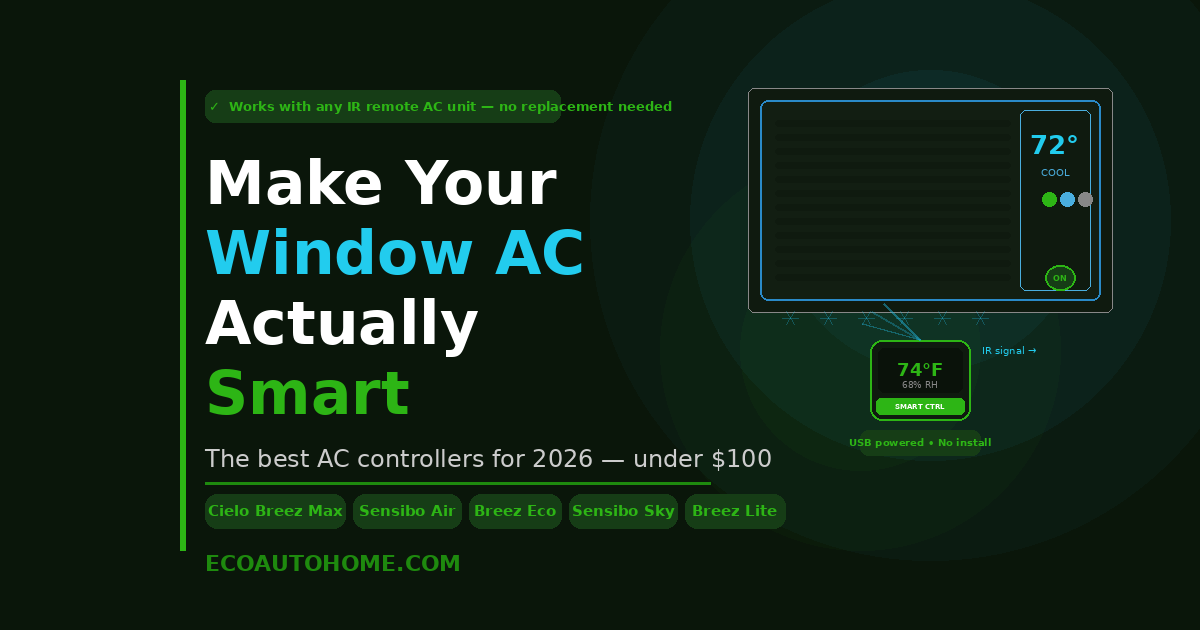
The fix for this is a $35 to $100 device that clips to your wall, connects to your Wi-Fi, and turns your existing window unit or mini-split into a fully smart appliance — with app control, scheduling, geofencing, and voice commands. No replacing the AC. No installation at all beyond plugging in a USB cable. No electrician. No landlord approval needed.
That device is a smart AC controller. It works by emitting infrared signals — exactly like your original remote — but takes commands from your phone, from Alexa, from Google Home, from Apple HomeKit, or from an automated schedule you set once and never think about again.
This guide covers the five best smart AC controllers available in 2026, ranked honestly by use case, with every spec confirmed from current manufacturer sources and independent testing.
How Smart AC Controllers Actually Work
Understanding the mechanism helps you set accurate expectations — and explains both their power and their one genuine limitation.
Your window unit, portable AC, or mini-split almost certainly came with a handheld infrared remote. That remote sends encoded IR signals to a receiver on your AC unit — telling it to power on, change mode, increase fan speed, or hit a target temperature. Your AC unit doesn’t have Wi-Fi. It doesn’t know what time it is. It can only respond to IR signals from a remote pointed at it.
A smart AC controller is a Wi-Fi-connected device that contains an IR blaster. You place it within line of sight of your AC unit — typically 6 to 12 feet away — and it learns your AC’s specific IR codes during a two-minute setup process. From that point, when you tap “cool to 72°F” in the app on your phone from work, the controller sends the exact same IR signal your original remote would have sent. Your AC unit responds as if you’d pressed the button yourself.
The one honest limitation: because smart AC controllers use IR, they require unobstructed line-of-sight to the AC unit’s receiver. If furniture, curtains, or room layout blocks the path between controller and AC unit, the signal won’t land reliably. This is a fixable problem — most controllers can be wall-mounted or placed on a stand to find the right angle — but it’s worth knowing before placing your order.
Everything else — scheduling, geofencing, temperature sensing, voice control, energy monitoring — works through the controller’s own smarts, not through the AC unit itself.
What to Look for in a Smart AC Controller
Compatibility with your specific AC unit. Smart AC controllers work with any AC that has an IR remote — but the controller needs to have your AC’s specific IR code database. Most major brands — LG, Samsung, Frigidaire, Carrier, Mitsubishi, Daikin, Toshiba, GE, and hundreds more — are supported by every controller on this list. If you have a less common brand, run your model through the manufacturer’s compatibility checker before ordering. Cielo lists over 20,000 compatible models. Sensibo supports over 10,000.
Built-in temperature and humidity sensors. A controller with on-board sensors can act as a true thermostat — measuring the actual room temperature and adjusting the AC to maintain a target, rather than just sending the same command regardless of conditions. This is the feature that transforms an IR blaster into a genuine smart thermostat experience. Every controller on this list includes both temperature and humidity sensing.
Physical controls on the device. Some controllers have no physical interface at all — they’re purely app-controlled. Others include a display showing current temperature and buttons to adjust the set point. If your phone dies or your Wi-Fi drops, a controller with physical controls lets you adjust your AC manually without finding the original remote. The Cielo Breez Max has the most complete physical interface in the category. The Sensibo Sky and Cielo Breez Eco have no physical controls.
Smart home platform compatibility. Alexa and Google Home support is universal across every pick on this list. Apple HomeKit native certification is rarer — only the Sensibo Air carries genuine HomeKit certification in this category in 2026.
No subscription required. All core features — scheduling, geofencing, voice control, usage history — should be free forever. Every pick on this list delivers full functionality with no subscription. The Sensibo Plus subscription adds AI-powered features like climate react and advanced historical data, but the free tier is complete and functional without it.
The 5 Best Smart AC Controllers in 2026
1. Cielo Breez Max — Best Overall
The Cielo Breez Max is the benchmark for smart AC controllers in 2026 — and it earned that position by being the only device in the category that wins on every dimension simultaneously: features, physical interface, app quality, AI intelligence, compatibility, and customer support.
Consumer Reports tested it alongside every major competitor and placed it at the top of their smart AC controller ratings. It received the AHR Expo Product of the Year award in its category. The Cielo Breez Max is Energy Star certified — a meaningful distinction in a product class not typically known for energy credentials.
The on-device interface sets it apart from every other controller. A clear LCD display shows current room temperature and humidity. Physical touch buttons let you adjust the set point, change modes, and power the unit on and off without touching your phone. This sounds like a small thing until your phone is dead and you’re trying to turn the AC off before bed. No other controller at or near this price point offers this.
Comfy Max is the Breez Max’s AI-powered automation feature. It monitors room temperature, humidity, and your usage patterns, then adjusts the AC’s set point, fan speed, and mode automatically to prevent overcooling and overheating. In practice, it behaves similarly to a learning thermostat — observing what you prefer and building a comfort profile that keeps the room consistently comfortable without running the AC harder than necessary. Cielo cites energy savings of up to 25% compared to manual operation.
Auto-detection identifies your AC unit’s IR codes automatically during setup, covering over 20,000 models. If auto-detection fails for any reason — which is rare — Cielo’s support team is available by phone and email, answering 98% of calls in under two minutes according to their own data, and manually adding compatibility when needed.
Schedule-based operation continues to run even if your internet connection drops. That’s an important reliability detail — most smart home devices become non-functional without internet. The Breez Max stores its schedule locally and executes it regardless of connectivity.
Platform support covers Alexa, Google Home, Siri Shortcuts, Samsung SmartThings, and IFTTT. Apple HomeKit is not natively supported on the Breez Max — that gap is filled by the Sensibo Air for Apple households.
Connectivity: 2.4GHz Wi-Fi Compatible units: 20,000+ models — mini-splits, window ACs, portable ACs, heat pumps Sensors: Temperature, humidity Physical controls: Yes — LCD display, touch buttons Smart home: Alexa, Google Home, Siri Shortcuts, SmartThings, IFTTT Energy Star: Yes Subscription required: No Price range: Around $100 to $120
Best for: Most households with any IR-remote-controlled AC unit who want the most complete feature set, best physical interface, and strongest AI-powered automation available.
2. Sensibo Air — Best for Apple HomeKit
If your home runs on Apple, the Sensibo Air is the smart AC controller to buy. It’s the only option in this category with genuine, native Apple HomeKit certification — not a Siri Shortcuts workaround, not a third-party bridge, but a device that appears directly in your Apple Home app alongside your other HomeKit accessories.
The Sensibo Air connects via both Bluetooth and Wi-Fi — a dual connectivity design that makes initial setup significantly smoother than Wi-Fi-only competitors. Bluetooth handles the pairing process instantly, then Wi-Fi takes over for ongoing remote control. The result is a setup process that typically completes in under 60 seconds.
The device is small, slim, and wall-mountable with an adhesive mount included. There are no physical controls on the Sensibo Air — operation is entirely through the app, voice assistants, or automations. The Sensibo app is clean and well-designed, offering full scheduling, geofencing, and usage history.
Climate React is Sensibo’s automation feature — it monitors room temperature and humidity in real time and triggers AC actions when conditions cross thresholds you define. Set it to start cooling when the room hits 78°F, or switch to fan-only mode when humidity drops below 50%. It’s not as AI-driven as Cielo’s Comfy Max, but it’s reliable and flexible for manual rule building.
Sensibo Air supports over 10,000 AC models and the same IR learning approach as other controllers — point your original remote at the device during setup and it captures the codes automatically.
One honest note: the Sensibo Air doesn’t include a display or physical controls. If you prefer a device you can interact with without a phone, the Cielo Breez Max is the better choice. But for Apple HomeKit households where all control happens through the Home app, Siri, or automations, the absence of physical controls is not a limitation in practice.
Connectivity: Wi-Fi + Bluetooth Compatible units: 10,000+ models Sensors: Temperature, humidity Physical controls: None Smart home: Apple HomeKit, Alexa, Google Home, Siri Subscription required: No (Sensibo Plus subscription available for advanced features) Price range: Around $100 to $120
Best for: Apple HomeKit households where native Home app integration and Siri automation are priorities.
3. Cielo Breez Eco — Best Mid-Range Pick
The Cielo Breez Eco delivers around 80% of the Breez Max’s functionality at roughly 65% of the price — and for most people’s actual daily usage, the things it omits are ones they wouldn’t miss.
What it keeps from the Max: temperature and humidity sensing, AI-powered Comfy mode, full scheduling, geofencing, usage history, Alexa and Google Home voice control, Siri Shortcuts, SmartThings, and IFTTT support. It covers 20,000+ models via auto-detection. It has a single physical on/off button on the device — not a full display or temperature controls, but enough to power the unit on and off without a phone.
What it omits compared to the Max: the full LCD display with temperature readout, the ability to adjust the set point physically on the device, and the Energy Star certification.
For someone whose primary interaction with the AC controller is through the app, schedules, and voice commands — which describes most people most of the time — the Breez Eco covers all of that at a meaningfully lower price. The savings become more significant when outfitting multiple rooms, where buying a Breez Max for every AC unit adds up quickly.
Connectivity: 2.4GHz Wi-Fi Compatible units: 20,000+ models Sensors: Temperature, humidity Physical controls: On/off button only Smart home: Alexa, Google Home, Siri Shortcuts, SmartThings, IFTTT Subscription required: No Price range: Around $65 to $80
Best for: Single-room setups or multi-room households where per-unit cost matters and physical temperature controls on the device are not a priority.
4. Sensibo Sky — Best Budget Option With Alexa and Google
The Sensibo Sky has been in the market longer than most competitors, accumulating over 4,900 Amazon reviews averaging 4.3 stars. That sustained user satisfaction across thousands of verified buyers speaks to something important: reliability over time, not just in initial testing.
It’s the most affordable verified-reliable smart AC controller on this list, typically around $55 to $70. It connects via 2.4GHz Wi-Fi, supports Alexa and Google Home, includes temperature and humidity sensors, and delivers full scheduling and geofencing through the Sensibo app. Auto-detection identifies most AC units immediately on first setup — Sensibo’s IR code database covers over 10,000 models.
The Sensibo Sky has no physical controls and no display — it’s app and voice only. Notably, it also does not support Apple HomeKit. For HomeKit users, the Sensibo Air is the right Sensibo product. For Alexa and Google households on a budget, the Sky covers everything that matters.
One practical difference from Cielo products: the Sensibo Sky stores its schedule in the cloud rather than locally. If your internet connection drops, scheduled commands may not execute. For most households with reliable broadband this is not a real-world issue — but it’s worth knowing if you’re in an area with frequent outages.
Connectivity: 2.4GHz Wi-Fi Compatible units: 10,000+ models Sensors: Temperature, humidity Physical controls: None Smart home: Alexa, Google Home, Siri (not native HomeKit) Subscription required: No (Sensibo Plus optional) Price range: Around $55 to $70
Best for: Budget-conscious buyers in Alexa or Google Home households who want proven long-term reliability at the lowest price on this list.
5. Cielo Breez Lite — Best for Renters and First-Time Users
If you’ve never used a smart AC controller before and want to try the concept without committing to a premium price point, the Cielo Breez Lite is the right starting point.
At under $50, it delivers the core smart AC experience — app control, scheduling, geofencing, voice control with Alexa and Google Home, temperature and humidity monitoring — with nothing added that a first-time user needs to configure or understand. There are no physical controls at all. Setup takes under 10 minutes following the Cielo Home app’s step-by-step guide, which walks through IR code detection automatically.
It covers the same 20,000+ model database as the Breez Max and Breez Eco, meaning compatibility is not the trade-off for the lower price. The trade-off is the absence of any physical interface, Comfy Max AI automation, Energy Star certification, and the advanced features of the higher-tier Cielo products.
For a renter who wants to walk into a cool apartment without waiting 45 minutes for a basic window unit to catch up, the Breez Lite solves that problem completely. It requires no permanent installation — it plugs into a standard USB outlet, mounts on the wall or sits on its included table stand, and removes in 30 seconds when you move out.
Connectivity: 2.4GHz Wi-Fi Compatible units: 20,000+ models Sensors: Temperature, humidity Physical controls: None Smart home: Alexa, Google Home, Siri Shortcuts, SmartThings, IFTTT Subscription required: No Price range: Around $40 to $55
Best for: Renters, first-time smart home users, secondary rooms, and anyone who wants the core experience at the lowest possible entry cost.
Which One Should You Buy?
The honest quick-pick breakdown:
Want the most complete feature set with physical controls on the device? Cielo Breez Max. AI-powered Comfy mode, LCD display, touch controls, Energy Star certified, 20,000+ model compatibility, schedule runs offline.
Apple HomeKit is your primary smart home platform? Sensibo Air. The only device with genuine native HomeKit certification. Everything else in this category requires a Siri Shortcuts workaround.
Want a strong mid-range option without the Max’s price? Cielo Breez Eco. Same 20,000+ compatibility, geofencing, scheduling, voice control — without the display and at a meaningfully lower price.
Want the most proven long-term budget option for Alexa or Google? Sensibo Sky. Thousands of verified reviews over years of real-world use. Reliable, simple, and the most affordable certified option on the list.
First-time user, renter, or secondary room? Cielo Breez Lite. Under $50, no installation, full core features, and easy enough for anyone to set up in under 10 minutes.
One thing worth doing before ordering any controller: check your AC unit’s model number against the compatibility list on the manufacturer’s website. Cielo maintains a public compatibility checker at cielo.com/compatibility. Sensibo maintains one at sensibo.com/works-with. Confirming compatibility before purchase takes 60 seconds and eliminates any risk of a return.
If you’re cooling a room that’s also part of a wider smart home setup — with smart plugs, smart lighting, and other connected devices — our guide on How to Save Electricity in an Apartment covers how all of these pieces work together to reduce your summer electricity bill, not just the AC controller in isolation.
FAQ
Do smart AC controllers work with all window air conditioners?
They work with any air conditioner — window, portable, or mini-split — that comes with an infrared remote control. If your AC unit can be controlled by a handheld IR remote, a smart controller can replicate those commands. If your AC unit has no remote at all — only physical controls on the unit body — a smart controller cannot communicate with it, because there is no IR receiver in the unit to receive signals. Check the compatibility list on the manufacturer’s website using your AC unit’s model number before ordering.
Do smart AC controllers require professional installation?
No. Every smart AC controller on this list is fully DIY — plug into a USB outlet, place within line-of-sight of your AC unit, download the app, and complete the two-minute setup process. No drilling, no wiring, no tools, no professional. This makes them ideal for renters who cannot make permanent modifications to their unit. Removal is equally simple — unplug the USB cable and take it with you.
Can smart AC controllers save money on electricity?
Yes, through scheduling and geofencing that stop the AC from running when nobody is home and start it before you return. Cielo claims up to 25% energy savings compared to unmanaged manual operation. The actual savings depend on how much your AC currently runs unnecessarily — a household that already turns the AC off every time they leave will see less savings than one that leaves the AC running all day. A controller that uses on-board temperature sensing to maintain a target temperature — rather than just running the AC at full blast — also reduces unnecessary runtime, which compounds the savings over a full summer.
What is the difference between a smart AC controller and a smart AC?
A smart AC is a new air conditioner unit with Wi-Fi built directly into the hardware — controlled through its own brand app without any additional device. A smart AC controller is an aftermarket add-on that adds smart functionality to any existing AC unit with an IR remote. Smart AC controllers are significantly cheaper than replacing your AC unit, require no installation, and work with any brand. The trade-off is reliance on IR line-of-sight and the fact that the controller reports room temperature from its own sensor rather than the AC unit’s internal sensor.
Do smart AC controllers work with mini-splits?
Yes — every controller on this list is designed for mini-splits as well as window and portable units. Mini-splits are among the best-supported AC types in the smart controller category because they almost universally ship with IR remotes and have reliable, well-documented IR code libraries. Multi-zone mini-split systems — where one outdoor unit drives multiple indoor heads — can be managed with one controller per indoor head, with the Cielo Breez Max offering a multi-zone mode conflict prevention feature that ensures all indoor heads stay in the same operating mode.
The Bottom Line
A smart AC controller is one of the highest-value smart home upgrades available in 2026. Under $100. No installation. Works with your existing AC. Turns a dumb, remote-only appliance into something you can schedule, geofence, automate, and voice-control from anywhere.
The Cielo Breez Max is the best overall choice for most households — the most complete feature set, the best physical interface, AI-powered automation, and the only Energy Star certified option in the category with on-device controls. The Sensibo Air is the right call for Apple households. The Cielo Breez Eco and Sensibo Sky serve the mid-range and budget cases with proven reliability.
You don’t need to replace your window unit to get smart AC control. You just need a $50 to $100 device, a USB outlet, and a clear line of sight to your AC.
For more practical smart home guides covering every season and every budget, explore EcoAutoHome.