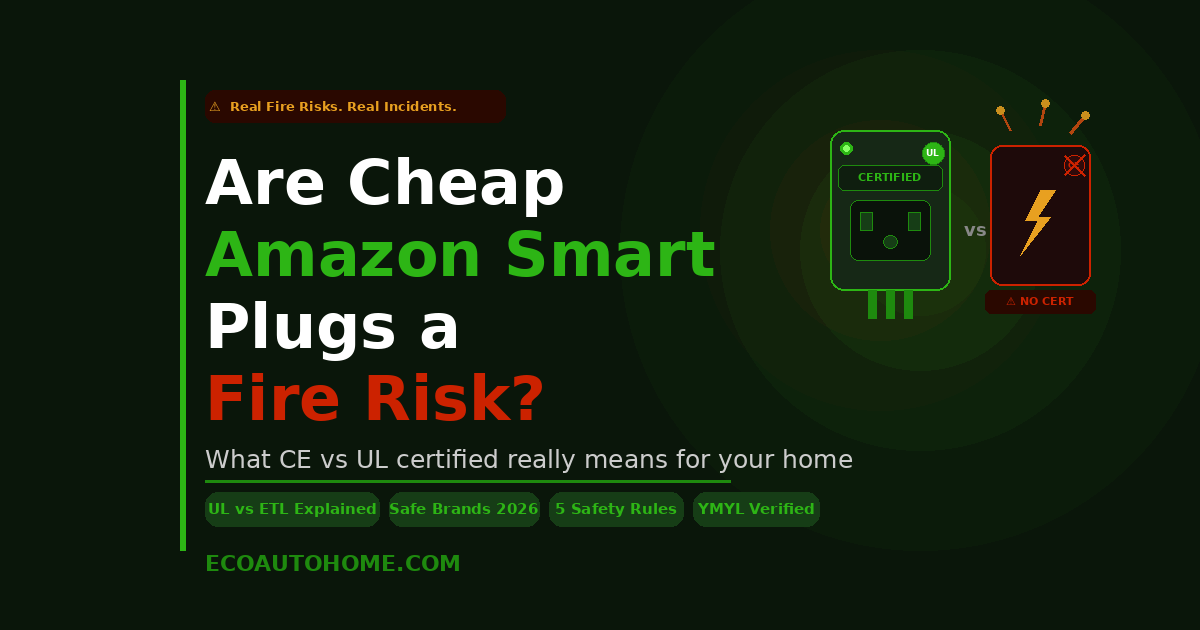
You’ve seen them. A four-pack of smart plugs for $9.99. No brand name you recognise. Hundreds of five-star reviews. And a little logo on the listing that says “CE certified” or “FCC approved.”
Here’s what most people don’t know: those certifications mean almost nothing for electrical safety. And in at least one documented case, a smart plug sold on Amazon was found to have a design flaw so serious that consumer safety researchers called it a genuine fire risk — not a theoretical one.
Smart plugs from reputable brands are genuinely safe and useful devices. But the flood of cheap, no-name alternatives on Amazon and other marketplaces includes products that have never been independently tested for electrical safety, products with internal designs that place live connections dangerously close to other components, and products bearing certification logos that were never earned.
This guide explains exactly what makes a cheap smart plug dangerous, how to read certification marks correctly, what appliances you should never connect to any smart plug, and which brands are actually worth trusting in 2026.
What Actually Happened: The Documented Fire Risk
In 2020, consumer safety organisation Which? — working with independent security consultants NCC Group — purchased ten smart plugs from Amazon and other online retailers and subjected them to independent safety and security testing. The results were serious enough to prompt immediate action.
One device — the Hictkon Smart Plug with Dual USB Ports, available on Amazon — was found to have the live electrical connection positioned too close to an energy-monitoring chip inside the device. That proximity creates the conditions for an electrical arc — a discharge of electricity between two conductive points — which is a known fire ignition source, particularly dangerous in older homes with older wiring. The researchers concluded this specific plug should not be sold. Which? notified Amazon, and Amazon removed it from sale pending investigation.
The same testing found 13 vulnerabilities across nine of the ten plugs tested — three rated as high impact and three classified as critical. Several devices were found to carry CE and FCC certification markings that the researchers suspected were counterfeit or applied without proper testing.
This is not a one-off edge case. It reflects a structural problem with how unverified electrical devices reach consumers through open marketplace platforms. Amazon, for its part, has taken action against individual products when formally notified — but the marketplace model means new products from unverified suppliers can appear faster than any review process can catch them.
Why CE and FCC Marks Don’t Protect You
This is the most important thing to understand before buying any cheap smart plug — and it’s the thing that trips up even careful shoppers.
You’ll see two types of certification marks on cheap smart plugs sold in the US: CE and FCC. Both look like safety endorsements. Neither one is what most people assume it is.
FCC certification means a device meets Federal Communications Commission requirements for radio frequency emissions — it won’t interfere with other wireless devices. It says nothing whatsoever about electrical safety. A device can pass FCC requirements and still have a design that creates fire risk.
CE marking is a European conformity mark, not a US safety certification. In Europe, it indicates a product meets certain EU directives. In the US, it has no legal meaning at all. Additionally — and this is the critical detail — CE marking in Europe is largely self-declared by manufacturers. There is no independent body that inspects every CE-marked product before sale. A manufacturer can place a CE mark on a product based on their own internal assessment, without any external verification.
In 2026, Amazon and UL jointly filed federal lawsuits against multiple Chinese sellers accused of placing counterfeit UL trademarks on electrical products without authorisation. The products bearing those fake marks had never been tested by UL at all. This practice extends well beyond e-bikes — it has been documented across electrical accessories including smart plugs.
The only marks that indicate genuine independent electrical safety testing for US residential use are UL Listed and ETL Listed. Both are OSHA-recognised Nationally Recognised Testing Laboratories. Both test to identical electrical safety standards. Both require manufacturers to submit their actual products for independent testing before the mark can be applied. Both conduct ongoing factory inspections to ensure production quality matches what was tested.
UL and ETL are genuinely equivalent in terms of the safety standard they certify to — the difference is primarily cost and processing time for manufacturers. A UL-listed smart plug and an ETL-listed smart plug both meet the same baseline requirements.
How to Verify a Certification Is Real
Here’s the step that most buying guides skip entirely — and it matters.
Just because a product listing says “UL Listed” does not mean it actually is. The UL certification database is publicly searchable at ul.com/resources/ul-product-iq. You can enter a manufacturer’s name or product model and verify whether that specific product holds a genuine UL listing. ETL maintains a similar verification database through Intertek at intertek.com.
If you’re considering a smart plug with a UL or ETL mark and you cannot find it in the corresponding database, treat that mark as unverified. Purchasing it is your choice — but you now know the certification claim has not been confirmed.
This verification step takes about 60 seconds and provides far more reliable information than any number of Amazon reviews.
The Overloading Problem: Even Certified Plugs Have Limits
A genuine UL-listed smart plug can still become a fire hazard if you use it incorrectly. Understanding the amperage and wattage rating of any smart plug is non-negotiable — and it’s a detail that a surprising number of people ignore.
Most smart plugs sold for residential use are rated at 15 amps and 1,800 watts. That ceiling exists for a reason. When the device connected to the plug draws more current than the plug is rated to handle, the plug overheats. Sustained overheating degrades the components inside, can damage the wall outlet itself, and in the worst case starts a fire.
The appliances most commonly used with smart plugs that exceed or approach safe load limits include space heaters, portable air conditioners, electric kettles, and clothes irons. A standard 1,500-watt space heater draws 12.5 amps — within the 15-amp rating of most smart plugs, but close enough to the ceiling that any voltage variation or degraded connection pushes it over. Running such a device through a budget smart plug on a continuous basis is a meaningful risk.
Standard budget smart plugs — particularly white-label multipacks without visible certification marks — often carry lower effective load ratings than their 15-amp nominal spec suggests, because the internal components were not built to sustain near-maximum loads over extended periods. A certified plug from a reputable brand at 15 amps sustained is a different device from an uncertified plug claiming the same rating.
For space heaters and other high-draw appliances, use only explicitly heavy-duty rated, UL or ETL certified smart plugs from recognised brands — or avoid smart plug control entirely and connect those devices directly to the wall.
Smart Plugs and Power Strips: A Combination to Avoid
This is a safety issue that deserves its own section because it’s extremely common and genuinely dangerous.
Plugging a smart plug into a power strip, or plugging a smart plug into another smart plug, creates a daisy-chained load path that power strips and extension cords are not designed to handle safely. Power strips are rated for intermittent loads across multiple outlets — not for a single device drawing continuous high current through one position.
Smart plugs should always be plugged directly into a wall outlet. If your wall outlet is occupied, the solution is to free up a direct wall outlet — not to route through a power strip. This applies to certified smart plugs from reputable brands, not only to cheap alternatives.
Which Smart Plug Brands Are Actually Safe in 2026?
There are several brands that consistently carry genuine UL or ETL certification, have been independently tested, and have real-world track records of reliable, safe operation.
TP-Link Kasa is the most consistently recommended brand across independent testing organisations including Consumer Reports, Wirecutter, PCMag, and CNET in 2026. The Kasa EP25 and KP125M are UL certified, support Matter for broad platform compatibility, include energy monitoring, and carry a flame-retardant housing. The four-pack brings the per-plug cost to around $7–8, which competes directly with no-name alternatives — without the safety compromise.
Amazon Smart Plug (Amazon’s own branded product, not third-party sellers on Amazon) is UL certified for 15-amp loads and integrates natively with Alexa with minimal setup. At around $13, it’s one of the cheapest certified options available. Note carefully: this refers to the plug sold and manufactured by Amazon directly — not the thousands of unbranded smart plugs listed on Amazon’s marketplace by third-party sellers.
Wyze Smart Plug carries UL certification, is available in four-packs at around $28, includes energy monitoring, and works with Alexa and Google Home. It’s a legitimate budget option from a brand with a known track record and real customer service.
GE Cync Smart Plug is UL listed, widely available at major US retailers, and works with Alexa and Google Home without a hub. It’s a solid choice for anyone who prefers buying from a physically established retail brand they can return products to.
The common thread across all of these is verifiable UL or ETL certification, a recognisable brand name that stands behind its products with a warranty and customer support, and availability through established retail channels — not only through Amazon marketplace third-party listings.
If you’re building out a broader smart home setup alongside your smart plugs, our guide on Smart Home Setup on a Budget covers how to expand your setup sensibly without compromising on safety or reliability at any price point.
5 Safety Rules for Smart Plugs — Regardless of Brand
Follow these regardless of which smart plug you buy.
Rule 1 — Verify the certification before you buy. Look for UL Listed or ETL Listed on the physical product packaging — not just in the Amazon listing description. Then verify that specific model in the UL or Intertek database online.
Rule 2 — Never exceed the rated wattage. Check the wattage of every appliance you plan to connect. If the appliance’s wattage is close to or exceeds the plug’s 1,800-watt rating, connect it directly to the wall instead.
Rule 3 — Always plug directly into a wall outlet. Never plug a smart plug into a power strip, extension cord, or another smart plug. The wall outlet is the only safe connection point.
Rule 4 — Do not use indoor plugs outdoors. An indoor-rated smart plug used in an outdoor location will eventually be exposed to moisture — even in a covered area. Outdoor use requires an IP-rated, outdoor-specific smart plug. Using the wrong plug outdoors risks electrical shock and fire.
Rule 5 — Unplug immediately if the device runs hot. A smart plug that is warm to the touch during normal use is operating within acceptable limits — all electrical devices generate some heat. A plug that is hot — too hot to touch comfortably — is a warning sign. Unplug it, stop using it, and do not reconnect it.
FAQ
Are cheap smart plugs from Amazon safe?
Some are and some aren’t — and the difference is whether they carry genuine UL or ETL certification from an independent testing laboratory. Smart plugs bearing only CE or FCC marks have not been independently tested for electrical safety in the US. A documented investigation by Which? found at least one cheap smart plug on Amazon with an internal design that posed a genuine fire risk. The safest approach is to buy from recognisable brands — Kasa, Amazon’s own branded plug, Wyze, GE Cync — that carry verified UL or ETL listings and have real customer support behind them.
What does UL Listed mean on a smart plug?
UL Listed means the product has been independently tested by Underwriters Laboratories — an OSHA-recognised Nationally Recognised Testing Laboratory — and found to meet specific electrical safety standards. To earn the listing, a manufacturer must submit the actual product for physical testing, not just documentation. UL also conducts ongoing factory inspections to verify that production quality matches the tested product. ETL Listed, issued by Intertek, means the same thing and certifies to identical safety standards.
Can a smart plug cause a fire?
Yes — under certain conditions. A smart plug with a design flaw that places live connections too close to other conductive components can cause electrical arcing, which is a fire ignition source. Any smart plug — certified or not — that is connected to an appliance drawing more current than its rated capacity can overheat and potentially cause a fire. Using a smart plug on a power strip rather than directly in a wall outlet increases this risk. Using a smart plug rated for indoor use in an outdoor location exposes it to moisture that can cause electrical faults. Following the five safety rules in this guide eliminates the most common risk factors.
Is CE certification the same as UL certification?
No — they are completely different. CE is a European conformity mark, largely self-declared by manufacturers, that indicates compliance with certain EU product directives. It has no legal meaning in the US. UL and ETL are US-specific independent testing certifications from OSHA-recognised labs that require physical product testing and ongoing factory inspections. A CE mark on a smart plug sold in the US tells you nothing about its electrical safety to US standards.
Can I plug a space heater into a smart plug?
Only if the smart plug is explicitly rated for high-draw appliances — specifically UL or ETL certified to 15 amps and 1,800 watts from a reputable brand, with a flame-retardant housing. Budget smart plugs and white-label multipacks should never be used with space heaters. Even with a properly rated smart plug, verify that your specific heater’s wattage stays below 1,800 watts and plug it directly into the wall outlet — never through a power strip. The scheduling and remote shutoff features a smart plug adds to a space heater are genuinely useful safety tools, but only when the plug itself is rated for the load.
The Bottom Line
Cheap smart plugs are not automatically dangerous — but a meaningful number of them genuinely are, and the certification marks most shoppers rely on to judge safety are either irrelevant to US electrical standards or straightforwardly fake on some products.
The real risk comes from two sources: uncertified plugs with poor internal design that can arc or overheat, and otherwise adequate plugs used incorrectly — overloaded with high-draw appliances, routed through power strips, or used outdoors without appropriate weatherproofing.
The solution is straightforward. Spend a few dollars more per plug on a recognisable brand that carries genuine UL or ETL certification — Kasa, Amazon’s own plug, Wyze, GE Cync. Verify the certification in the UL or Intertek database before you buy. Plug it directly into the wall. Stay within the rated wattage. And if it ever runs hot, unplug it permanently.
A smart plug that costs $8 instead of $3 and actually meets safety standards is not an expensive purchase. A house fire is.
For more honest smart home guides built around real-world safety and practical value, explore EcoAutoHome.


it,s jast osam