
Your electricity bill arrived. Again. And it’s higher than last month — even though you don’t think you’ve been doing anything differently.
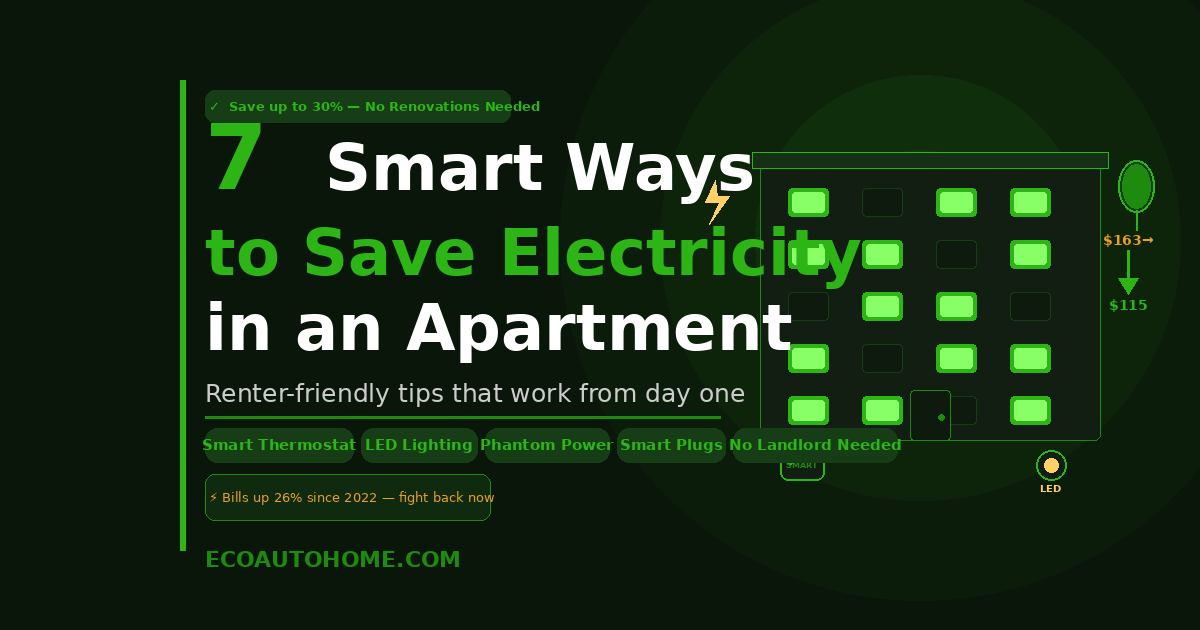
You’re not imagining it. The average US residential electricity bill hit $163 per month in April 2026, up 26% from just four years ago, according to data from the US Energy Information Administration. For apartment renters specifically, bills typically land between $70 and $150 per month depending on location, season, and building efficiency — and with national rates rising around 5% year over year, waiting it out isn’t a strategy.
The good news is that apartment electricity bills are genuinely reducible — often by 15 to 30% — without landlord approval, major renovations, or expensive equipment. Most of the biggest wins come from a combination of small habit changes and affordable smart home upgrades that work in any rental. This guide covers seven practical, renter-friendly ways to cut your electricity bill starting this month.
Where Your Electricity Bill Actually Goes
Before jumping into the tips, it helps to know which appliances are eating your budget — because most people guess wrong.
According to the US Energy Information Administration, heating and cooling accounts for roughly 46% of the average home’s electricity consumption. Water heating follows at around 14%. Laundry — washer and dryer combined — accounts for around 13%. Lighting sits at 9%. Refrigeration at 7%. Everything else — TVs, laptops, phone chargers, gaming consoles, small appliances — fills the remaining 11%.
That breakdown matters because it tells you where your effort produces the most result. Obsessing over phone charger usage while your thermostat runs unchecked is like bailing water with a spoon while leaving the tap running. The big savings are in HVAC, water heating, and phantom power — and that’s where this guide focuses first.
Tip 1: Put Your Thermostat to Work Smarter
Heating and cooling is nearly half your electricity bill. It’s also the area where smart technology produces the most measurable savings for the least effort.
If your apartment has a standard programmable thermostat — or no programmable thermostat at all — you’re likely heating or cooling an empty apartment for hours every day without thinking about it. Every degree you lower your heat in winter saves around 3% on your heating costs, according to the US Department of Energy. Running your cooling at 78°F instead of 72°F in summer saves 15 to 20% on cooling alone.
A smart thermostat automates these adjustments without you having to think about them. Geofencing uses your phone’s location to detect when you’ve left home and automatically dials back the heating or cooling. Scheduling lets you set comfortable temperatures only when you’re actually there. Learning algorithms on higher-end models figure out your patterns after a week and do all of this without any manual setup at all.
Many landlords approve smart thermostat installation because the device is removable without any wall damage — it replaces the existing thermostat with no new wiring required on most systems. The ecobee SmartThermostat Essential and the Google Nest Learning Thermostat 4th Gen both install in under 30 minutes and are fully reversible on move-out day. Energy Star data confirms that properly used smart thermostats save homeowners and renters between $100 and $250 annually on heating and cooling costs — often paying for themselves within the first year.
If your landlord won’t approve a permanent thermostat change, adjusting your existing thermostat manually whenever you leave for more than a couple of hours delivers much of the same benefit, just without the automation.
Tip 2: Kill Phantom Power — Your Invisible Bill
This one surprises people every time. The US Department of Energy has documented that standby power — the electricity drawn by devices that are plugged in but switched off or in standby mode — accounts for 5 to 10% of total residential energy use and can cost the average household up to $183 per year.
The worst offenders aren’t the ones people expect. Your phone charger left plugged in draws power even when no phone is connected. Your TV in standby mode draws 2 to 5 watts continuously. A cable or satellite box runs at around 15 to 20 watts around the clock — even at 3am when nobody is watching anything. Gaming consoles, desktop computers left in sleep mode, and audio equipment all contribute. Add them up across a typical apartment and you’re looking at a meaningful portion of your monthly bill going to devices doing absolutely nothing useful.
The fix is straightforward. For devices you use daily — TV, gaming console, streaming stick — plug them into a smart power strip and cut power with one switch when you go to bed. For devices you use intermittently — coffee maker, toaster, phone chargers — unplug them when not in use. For anything in your home office setup, a single smart power strip with a master outlet lets you cut power to your entire desk with one button.
Smart plugs with energy monitoring — like the Kasa EP25 or the Wyze Smart Plug — take this further by showing you exactly how much each device is drawing in real time. Once you can see that your old printer is pulling 8 watts 24 hours a day for something you print twice a month, the decision to keep it unplugged becomes automatic.
Tip 3: Replace Every Bulb With LED
If you’re still running any incandescent or CFL bulbs, switching to LEDs is the single fastest return on a small investment available in your apartment.
LED bulbs use 75 to 80% less energy than incandescent bulbs to produce the same light output. They last 25 times longer — typically 15,000 to 25,000 hours versus a standard bulb’s 1,000 hours. A six-pack of quality LED bulbs costs around $12 to $18 and pays itself back within a few months of typical use.
Most landlords are perfectly fine with tenants switching to LED bulbs — you’re improving the unit at your own expense and saving yourself money in the process. When you move out, you can swap the original bulbs back in or simply leave the LEDs as a gesture of goodwill.
Smart LED bulbs add scheduling and dimming capabilities on top of the base energy savings. Dimming an LED by 25% reduces its energy consumption by a similar proportion while extending the bulb’s lifespan further. Motion-sensing smart bulbs in bathrooms, closets, and hallways ensure lights never run in empty rooms — one of the most common sources of wasted lighting electricity in apartment buildings.
The savings from a full apartment LED conversion are typically $5 to $15 per month depending on your current bulb types and how many light fixtures you have. Modest in isolation — but consistent and permanent from month one.
Tip 4: Change How You Do Laundry
Laundry accounts for around 13% of residential electricity use — and most of that cost is concentrated in a single fixable habit: washing clothes in hot water.
Heating water is where the energy goes. The washing machine’s motor and drum use relatively little electricity. But heating water from cold to hot takes significant energy every single cycle. Switching to cold water washing eliminates that energy draw almost entirely — and modern detergents are specifically formulated to clean effectively in cold water. The American Cleaning Institute confirms that cold water washing cleans as effectively as warm water washing for the vast majority of everyday laundry loads.
The US Department of Energy estimates that washing in cold water saves the average household around $60 to $70 per year on water heating costs alone. For an apartment where electricity bills are already a concern, that’s a meaningful and completely free change that takes zero effort beyond turning a dial.
On the dryer side, running full loads rather than partial ones maximises efficiency per cycle. Cleaning the lint filter before every cycle — not occasionally, but every single time — improves airflow and reduces drying time by allowing the dryer to work efficiently. Over-dried clothing doesn’t save energy — it damages fabric and adds unnecessary run time. Using the moisture sensor setting rather than a fixed time cycle stops the dryer the moment clothes are dry, not a minute later.
If you have in-unit laundry control, running loads during off-peak hours — typically late evening or early morning — reduces costs in areas where your utility charges time-of-use rates. Check your electricity bill or your utility’s website to see if your plan includes time-based pricing. Many apartment renters in deregulated states are on time-of-use rates without realising it.
Tip 5: Seal Your Drafts Without Touching the Walls
Air leaks around windows and doors can add 10 to 20% to your heating and cooling bill. In an apartment, they’re especially common around single-pane windows, sliding door frames, and the gap under exterior doors. Every cubic foot of warm air that escapes in winter is a cubic foot your heating system has to replace at your expense.
The renter-friendly approach uses temporary, removable solutions that leave no permanent marks and come off cleanly on move-out day.
Draft stoppers — fabric tubes placed along the bottom of exterior doors — eliminate the cold air channel that accounts for a surprising amount of heat loss in apartments with gaps under their front or balcony doors. They cost $10 to $20 and require no installation at all.
Removable weatherstripping tape seals gaps around window frames and door perimeters. It adheres temporarily and peels off cleanly. Applied around drafty window edges, it noticeably reduces both cold air infiltration in winter and hot air infiltration in summer.
Thermal curtains — thick, lined curtains that reduce heat transfer through windows — provide genuine insulation without modifying the window itself. In winter, they retain room warmth. In summer, closing them during peak afternoon sun significantly reduces how hard your AC has to work. A quality pair costs $30 to $60 and the energy savings across a full heating or cooling season routinely exceed that within the first year.
Tip 6: Use Smart Plugs to Automate the Habits You Forget
The problem with most energy-saving advice is that it depends on you remembering to do things consistently. You’ll remember to unplug the TV power strip for the first three days and then stop. You’ll set a rule to turn off the lights when you leave and break it when you’re running late.
Smart plugs solve this by making the good habit automatic. A smart plug connected to your lamp sets it to turn off at 11pm every night regardless of whether you remember. A smart plug on your desk setup powers everything down on a schedule — not whenever you think to do it. Smart plugs with geofencing turn off devices when your phone leaves the apartment and turn them back on when you return, without any manual action required.
The Kasa Smart Plug four-pack brings the per-plug cost to around $7 to $8. The Wyze Smart Plug four-pack is similarly priced. At that cost, a single good automation habit — like making sure your entertainment centre powers off every night at midnight — pays back the hardware cost within a few months.
Smart plugs also serve as a bridge for appliances that don’t have built-in smart features. Your existing floor lamp, window fan, coffee maker, and space heater all become schedulable and remotely controllable the moment a certified smart plug is involved. For renters who can’t modify permanent fixtures, this is the most accessible path to a meaningfully automated apartment.
For a deeper look at how to build out a complete smart plug setup safely — including which appliances should never be connected to a standard smart plug — our guide on Are Cheap Amazon Smart Plugs a Fire Risk covers exactly what to look for and which brands to trust.
Tip 7: Track Your Usage So You Know What to Fix
You cannot optimise what you cannot measure. Most people have no idea which appliances in their apartment are responsible for the majority of their electricity bill — and they end up focusing effort on low-impact changes while high-impact items run unchecked.
Smart plugs with energy monitoring — like the Kasa EP25 — show you real-time and historical wattage data for every device they’re connected to, directly in the app. Plug in your space heater and you’ll see it drawing 1,500 watts every time it runs. Plug in your old desktop computer and discover it’s pulling 180 watts in sleep mode. These numbers make prioritisation obvious.
For whole-apartment visibility, a plug-in energy monitor like the Sense Home Energy Monitor or a basic kill-a-watt meter can identify your largest energy consumers without requiring smart plugs on every outlet. Some utility companies also provide free or low-cost smart meter apps that show your hourly consumption — check your utility’s website to see what monitoring tools they offer, since many renters don’t know these free resources exist.
Once you know where your electricity is actually going, the savings compound quickly. You stop wasting effort on things that don’t move the needle and start targeting the three or four items that account for the bulk of your bill. That combination of measurement and targeted action is what separates a 5% reduction from a 25% one.
FAQ
How much can I realistically save on my apartment electricity bill?
Research from Energy Star and multiple utility studies consistently shows that a combination of behavioural changes and renter-appropriate smart home upgrades can reduce apartment electricity costs by 15 to 30%. On a $100 monthly bill, that’s $15 to $30 per month — or $180 to $360 per year. The largest single savings opportunity is typically heating and cooling optimisation, which alone can account for 8 to 20% savings depending on your current habits and thermostat settings.
Do I need my landlord’s permission to install a smart thermostat?
In most cases, yes — a quick conversation with your landlord or property manager is the right approach before changing any installed hardware. However, smart thermostats are generally easy to approve because they replace the existing thermostat with no wall damage and are fully reversible on move-out. Many landlords approve them readily once they understand the device is temporary and their property benefits from reduced HVAC wear through better scheduling. If your landlord declines, focusing on smart plugs, LED lighting, and habit-based changes still delivers meaningful savings.
Is it worth switching to LED bulbs in a rental apartment?
Yes — without question. LED bulbs are one of the highest return-on-investment changes available in any living situation. A full apartment LED conversion typically costs $20 to $40 and delivers $5 to $15 per month in electricity savings from month one. Most landlords do not object because you’re improving their unit. When you move out, you can take your LED bulbs with you or leave them — either way the economics work strongly in your favour.
What is phantom power and how much does it actually cost?
Phantom power — also called standby power or vampire energy — is the electricity drawn by devices that are plugged in but not actively in use. The US Department of Energy documents that it accounts for 5 to 10% of total residential energy consumption and can cost up to $183 per year in the average household. Common contributors in apartments include TVs in standby mode, gaming consoles, desktop computers in sleep mode, cable boxes running continuously, and phone chargers left plugged in without a device attached. Smart power strips and smart plugs eliminate most of this waste automatically.
Can apartment renters qualify for utility rebates on smart home devices?
Yes — and many renters don’t know this. Utility companies in most US states offer rebates, bill credits, and free energy audits that apply to renters as well as homeowners. Qualifying products often include smart thermostats, LED lighting, and Energy Star certified appliances. The availability and amounts vary significantly by utility and state. Check your utility provider’s website directly — search for “rebates” or “energy efficiency programmes” — or call their customer service line and ask specifically about renter-eligible incentives. Some programmes provide rebates of $25 to $75 on a qualifying smart thermostat, significantly reducing the upfront cost.
The Bottom Line
Electricity rates have risen 26% since 2022 and are projected to keep climbing. Waiting for bills to come down is not a plan. But you don’t need to own your home, renovate anything, or spend hundreds of dollars to meaningfully reduce what you pay every month.
The seven tips in this guide work in any apartment, require no permanent changes to the property, and most of them cost nothing at all. Start with thermostat optimisation and phantom power elimination — those two alone can cut 10 to 20% off most apartment bills. Add LED lighting and cold-water laundry for consistent monthly savings on top. Layer in smart plugs and draft sealing to automate the habits you’d otherwise forget.
Small changes, sustained consistently, compound into real money over a year. On a $120 monthly electricity bill, a 25% reduction puts $360 back in your pocket every year — without touching a single wall.
For more practical smart home guides that save you money and work in real rental apartments, explore EcoAutoHome.



One Comment