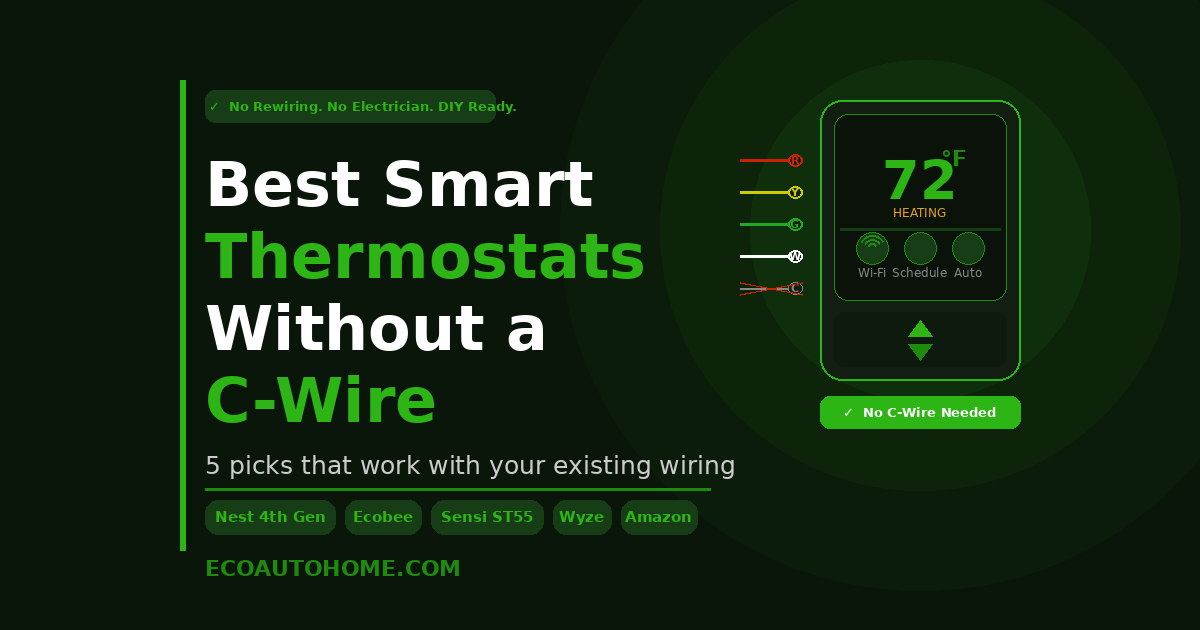
You pull off your old thermostat. You count the wires. And then you search the label on each one — R, Y, G, W — and realise there’s no C wire anywhere in sight.
For a lot of homeowners, this is where the smart thermostat upgrade grinds to a halt. Most smart thermostats list a C-wire as a requirement. If your home was built before the 1990s, there’s a good chance it doesn’t have one. And the idea of hiring an electrician to run new wiring through your walls just to install a thermostat feels like a lot of effort for something that should be straightforward.
Here’s the reality in 2026: not having a C-wire is no longer a genuine barrier. The best smart thermostats on this list solve the problem in different ways — some steal a trickle of power from your existing wires, some ship with a plug-in adapter that installs in your furnace in ten minutes, and some run on AA batteries so cleanly that the C-wire question never comes up at all. Every option on this list installs without running new wire or calling a professional.
This guide covers the five best no-C-wire smart thermostats in 2026, explains exactly how each one solves the power problem, and tells you which one fits your specific system.
First: What Is a C-Wire and Why Do Smart Thermostats Want One?
Before jumping into the picks, it’s worth understanding what the C-wire actually does — because knowing this helps you choose the right solution for your home.
A C-wire — short for common wire — is the return path that completes the 24-volt AC circuit between your thermostat and your HVAC system’s control board. It doesn’t control heating or cooling directly. Its job is simply to provide constant, uninterrupted power to the thermostat. Without it, the thermostat has no dedicated power supply.
Traditional dumb thermostats didn’t need constant power — they used simple mechanical or bimetallic switches that required almost no electricity. Smart thermostats are different. They run Wi-Fi radios, touchscreens, motion sensors, learning algorithms, and app connectivity. All of that requires a steady power source. The C-wire provides it cleanly and reliably.
When there’s no C-wire, smart thermostat manufacturers have engineered three main workarounds. The first is power stealing — the thermostat draws a tiny trickle of current from the control wires when the HVAC system is off, storing it in an internal battery. The second is a C-wire adapter — a small module that installs at the furnace control board and repurposes an existing wire or adds a low-voltage power path. The third is battery power — the thermostat runs entirely on AA batteries, with no connection to your HVAC system for power at all.
Each approach works — but they have different trade-offs, and which one suits you depends on your system type, your wiring, and what smart features matter most to you.
How to Check Your Wiring Before You Buy Anything
Spend two minutes doing this before ordering any thermostat. It saves you a return.
Turn off your HVAC system at the breaker. Remove the thermostat’s wall plate and gently pull the unit away from the wall to expose the wiring. Take a photo of the wiring before disconnecting anything — you’ll want this reference during installation.
Look at the wire labels on each terminal. If you see a wire connected to a terminal labelled C, you have a C-wire and this guide isn’t strictly necessary — though the thermostats here will still work fine for you. If you only see R, Y, G, and W terminals with wires, and no C terminal has a wire connected, you’re in the no-C-wire camp this guide is built for.
Now check the wire bundle in the wall. Even if no wire is currently connected to the C terminal, there may be an unused wire tucked inside the wall cable that was never terminated. Pull the bundle gently and look for an extra wire — typically white or blue. If one is there, you can connect it to the C terminal on the new thermostat and the C terminal on your furnace control board. That’s the cleanest fix of all, costs nothing, and gives you a fully powered C-wire in under 15 minutes.
If there’s no spare wire available, read on. Every pick below solves that problem cleanly.
The 5 Best Smart Thermostats Without a C-Wire in 2026
1. Google Nest Learning Thermostat 4th Gen — Best Overall
The Nest Learning Thermostat 4th Gen is the benchmark for no-C-wire smart thermostats in 2026 — and for good reason. Google’s Power Sharing technology draws a small, controlled trickle of current from your existing R wire, storing it in an internal rechargeable battery. No external adapter. No furnace access required. No extra hardware. You connect the same wires your old thermostat used, and it works.
Installation on a standard four-wire system takes around 20 to 30 minutes following the Google Home app’s step-by-step guidance. The app walks you through every wire connection with photos and labels specific to your system. I’ve seen first-time DIYers nail this in under 25 minutes without touching a screwdriver for anything other than the wall anchors.
The 4th Gen Nest is the most significant upgrade to the line in nearly a decade. The display is 60% larger than the previous model, with a Dynamic Farsight feature that wakes the screen when you approach and shows temperature, time, or weather from across the room. It learns your schedule and preferences over the first week of use, automatically dialling back heating and cooling when you’re away and restoring comfort settings before you return. Energy Star certification and real-world testing from Consumer Reports confirm around 10 to 12% savings on heating costs.
It works with most 24V systems — gas, electric, oil, forced air, heat pump, and radiant — and is Matter compatible, meaning it integrates with Alexa, Google Home, Apple Home, and SmartThings. One Nest Temperature Sensor is included in the box, letting you measure temperature in a room away from the thermostat and use that reading to drive your comfort settings.
The one honest limitation: power stealing can cause issues on certain older or highly sensitive HVAC systems — particularly some boilers, microvolt systems, and high-impedance setups. If your system is unusual, use Google’s Nest Compatibility Checker at g.co/nest/cwire before buying. If your system needs a C-wire specifically, Google sells the Nest Power Connector separately for around $25.
Best for: Most homes with standard forced-air HVAC systems. The simplest, most polished no-C-wire installation available.
Price range: Around $279 for the 4th Gen. Check for utility rebates through Energy Star — savings of up to $100 are available in some regions.
2. Ecobee SmartThermostat Enhanced — Best for Apple HomeKit and Multi-Stage HVAC
Ecobee is the only major smart thermostat brand that ships with its C-wire solution already in the box — no separate purchase, no compatibility checking before you order. The SmartThermostat Enhanced includes the Power Extender Kit, which installs at your furnace control board and repurposes the G wire (fan terminal) to create a reliable power path for the thermostat. It works with 90% of systems, including multi-stage heating and cooling and heat pumps.
Installation takes around 30 to 45 minutes including the furnace step, which involves opening the furnace door, identifying the control board, and connecting the Power Extender Kit with a magnetic mount. Ecobee’s in-app instructions are genuinely thorough — colour-coded wire diagrams for dozens of system configurations. The added furnace step is the trade-off for the built-in reliability of a dedicated power solution.
The Enhanced is ecobee’s mid-tier model in 2026, and it earns its place. Built-in radar occupancy sensing adjusts the temperature based on whether anyone is home — not just geofencing your phone, but actual on-device presence detection that works even when your phone is out of battery. It integrates with Apple HomeKit natively, making it the right choice for households running Apple Home alongside Alexa or Google. It’s also Matter compatible and works with SmartThings and IFTTT.
Ecobee SmartSensors — sold separately in two-packs — can be placed in any room to measure temperature and occupancy there, letting the thermostat prioritise comfort in the rooms you’re actually using rather than the hallway where the thermostat is mounted.
Energy Star certification claims up to 26% savings on heating and cooling costs compared to a constant 72°F hold. The three-year warranty is among the best in the category.
Best for: Apple HomeKit households, multi-stage HVAC systems, heat pumps, and anyone who wants the most comprehensive no-C-wire solution shipped ready in the box.
Price range: Around $189 to $220. The Power Extender Kit is included.
3. Emerson Sensi ST55 — Best for 2-Wire and Boiler Systems
This is the thermostat most smart home guides overlook — and it’s exactly the right call for a specific and very common situation.
If your home has a boiler, radiant heat, or any heating-only system running on just two wires — R and W — you’ve probably already discovered that most smart thermostats don’t play well with your setup. The Nest’s power stealing can cause a boiler to cycle on and off erratically on sensitive systems. Ecobee’s Power Extender Kit isn’t compatible with millivolt or high-voltage systems.
The Emerson Sensi ST55 runs on two standard AA batteries and draws no power from your HVAC wiring at all. That means it works cleanly on two-wire, heat-only boiler systems without any compatibility issues, without causing unwanted cycling, and without requiring you to buy additional adapters. Battery life runs well over a year on a standard pair of AAs.
For a standard forced-air system, the ST55 also works without a C-wire — it pulls what little power it needs from the existing wiring without the sensitivity issues the Nest can have on older systems. The Sensi app handles scheduling, geofencing, and remote control cleanly, and it integrates with Alexa and Google Home. Energy Star certified. Installation typically takes under 30 minutes.
The trade-off compared to the Nest or Ecobee is features — there’s no learning algorithm, no built-in occupancy sensor, and no Apple HomeKit support. But for someone who just wants reliable smart control of a boiler or radiant system without complicated workarounds, the ST55 solves the problem that everything else struggles with.
Best for: Boilers, radiant heating, 2-wire heat-only systems, and anyone who has already tried other smart thermostats and had compatibility problems.
Price range: Around $60 to $75. No additional hardware required.
4. Amazon Smart Thermostat — Best Budget Option With Adapter Included
The Amazon Smart Thermostat isn’t the flashiest device on this list — but at around $60 and with a C-wire adapter already in the box, it’s the most accessible entry point into no-fuss smart thermostat control in 2026.
The included adapter plugs into your furnace’s control board and provides a reliable low-voltage power path to the thermostat — similar to ecobee’s approach but without the furnace wiring step being as involved. Total installation time on a standard system with no C-wire runs around 30 to 40 minutes. Setup through the Alexa app is streamlined — genuinely one of the faster app-guided installations in the category.
It integrates deeply with Alexa, supports scheduling and geofencing through the Alexa app, and qualifies for the Alexa Hunches feature — where Alexa can suggest energy-saving adjustments based on your routine. It works with Google Home as well. Energy Star certified.
Where it falls short is obvious: no learning algorithm, no HomeKit, no occupancy sensing, and no ecosystem beyond Alexa for advanced automation. The display is functional but basic compared to the Nest’s Dynamic Farsight or Ecobee’s touchscreen. For a household that’s primarily Alexa-driven and wants reliable smart thermostat control without paying for features they won’t use, it delivers everything that matters.
Best for: Alexa households, budget-conscious buyers, first smart thermostat installs.
Price range: Around $59 to $65, with C-wire adapter included.
5. Wyze Smart Thermostat — Best Value for Feature-to-Price Ratio
Wyze has built a reputation for packing solid features into products that cost significantly less than the competition — and the Wyze Smart Thermostat continues that pattern.
At around $50, it ships with a C-wire adapter in the box, includes a colour touchscreen, supports full scheduling and geofencing, integrates with Alexa and Google Home, and delivers energy monitoring so you can track what your HVAC system is actually spending. That feature set at that price point is hard to argue with.
Installation follows the same adapter-at-furnace-board process as the Amazon Smart Thermostat — around 30 to 40 minutes on a standard system. The Wyze app is clean and straightforward. Energy Star certification is included.
The limitations are real but manageable. No Apple HomeKit support. No learning algorithm — schedules are manual. The Wyze platform has had documented connectivity reliability issues compared to Nest and Ecobee, with occasional app disconnects that resolve on their own but are frustrating in the moment. For a primary thermostat in a home where reliability is paramount, Ecobee or Nest edge it out. For a secondary zone, a guest room thermostat, or someone dipping into smart home upgrades for the first time on a tight budget, the Wyze Smart Thermostat is a genuinely good starting point.
Best for: Budget buyers, multi-zone secondary thermostats, first-time smart home upgrades.
Price range: Around $49 to $55, with C-wire adapter included.
Which One Is Right for Your System?
Here’s the honest quick-pick guide based on your situation:
Standard forced-air system, most homes built after 1985: The Google Nest Learning Thermostat 4th Gen installs cleanest and delivers the best experience. Use the Compatibility Checker first.
Apple HomeKit household or multi-stage/heat pump system: Ecobee SmartThermostat Enhanced with the included Power Extender Kit. Only option here with native HomeKit support.
Boiler, radiant heat, or 2-wire system: Emerson Sensi ST55. Battery-powered, no compatibility issues, no risk of unwanted cycling on sensitive systems.
Primarily Alexa household, want to keep costs low: Amazon Smart Thermostat with included adapter. Reliable, simple, and well-integrated with the Alexa ecosystem.
Tightest budget, willing to trade some reliability for price: Wyze Smart Thermostat with included adapter delivers solid features at the lowest total cost.
One thing worth checking regardless of which model you choose: both Google and Ecobee maintain free online compatibility checkers — at g.co/nest/cwire for Nest and ecobee.com/compatibility for Ecobee. Running your wiring configuration through either tool before ordering takes under two minutes and confirms whether an adapter is needed or whether your existing wiring handles it cleanly.
If you’re building out your full smart home setup alongside the thermostat, our comparison of the Ecobee vs Nest Smart Thermostat goes deeper on how these two top-tier options stack up across every dimension — including energy savings, app quality, and long-term reliability.
FAQ
Do all smart thermostats need a C-wire?
No — and in 2026, the majority of popular smart thermostats have engineered solutions that eliminate the C-wire requirement. Google Nest uses Power Sharing technology to draw a trickle of current from existing wiring. Ecobee ships with a Power Extender Kit that installs at the furnace control board. The Emerson Sensi ST55 and Amazon Smart Thermostat include battery or adapter solutions. None of the thermostats on this list require you to run new wire through your walls.
What happens if a smart thermostat doesn’t get enough power without a C-wire?
The most common symptoms are the thermostat frequently losing its Wi-Fi connection, the display going blank or restarting unexpectedly, or — in the case of power-stealing thermostats on sensitive systems — your furnace or boiler cycling on and off erratically when the system should be idle. If you experience any of these issues after installing a power-stealing thermostat, the fix is usually adding a proper C-wire connection or switching to an adapter-based solution like the ecobee Power Extender Kit.
Can I install a smart thermostat without a C-wire myself?
Yes — all five thermostats on this list are designed for DIY installation and include detailed step-by-step instructions through their companion apps. No special electrical knowledge is required. The most involved installation is the Ecobee SmartThermostat Enhanced, which requires opening your furnace door to connect the Power Extender Kit at the control board. That step adds about 15 minutes but is fully guided in the ecobee app. Always turn off your HVAC system at the breaker before handling any wiring.
Is power stealing safe for my furnace or boiler?
Yes — when implemented correctly by reputable manufacturers, power stealing draws such a small amount of current that it does not harm HVAC components. The issue arises specifically on older or highly sensitive control boards that misinterpret the trickle draw as a signal to activate. Google and Nest both document which system types may experience this, and their Compatibility Checker flags these configurations specifically. If your system is flagged, use the Nest Power Connector adapter or choose an adapter-based thermostat like Ecobee instead.
Will I save money on energy bills with a no-C-wire smart thermostat?
Yes — the smart features that drive energy savings are identical whether or not a C-wire is present. Scheduling, geofencing, learning algorithms, and occupancy sensing all work through the no-C-wire solutions described here. Ecobee claims up to 26% savings on heating and cooling costs compared to a constant temperature hold. Google Nest reports around 10 to 15% savings in real-world testing. The US Department of Energy confirms that programmable and smart thermostats generate meaningful energy savings when used correctly — and the automation features in these devices do most of that work for you without any ongoing effort.
The C-Wire Problem Is Solved
Not having a C-wire used to mean either calling an HVAC professional to run new wire or accepting that your home wasn’t compatible with smart thermostats. Neither of those things is true in 2026.
Every thermostat on this list handles the power problem through a different engineering approach — and each one is proven across millions of installations in real homes. The Google Nest Learning Thermostat 4th Gen is the cleanest starting point for most standard systems. The Ecobee SmartThermostat Enhanced is the right call for Apple households, multi-stage systems, and anyone who wants the most capable device with the adapter already in the box. The Emerson Sensi ST55 solves the problem nobody else solves well — two-wire boiler and radiant systems.
Check your wiring. Run the compatibility tool for whichever thermostat you’re considering. Install it on a Saturday morning. Your home will be smarter, your energy bills lower, and the C-wire will be a problem you’ve already solved.
For more practical smart home guides covering real installations in real homes, explore EcoAutoHome.