
It’s one of the most common questions in the smart home space — and one of the most honestly answered.
Yes, smart thermostats save money. But how much they save, how quickly they pay back their cost, and whether they’re worth it for your specific situation depends on factors that most buying guides gloss over entirely. The marketing numbers sound impressive. The real-world numbers are more nuanced. And understanding the difference is the only way to decide whether a smart thermostat actually makes financial sense for your home in 2026.
This guide breaks down the actual savings data — from EPA studies, independent utility trials, and manufacturer-published research — alongside the honest limitations that determine whether those numbers apply to you.
What the Data Actually Says
Let’s start with the most credible numbers, because the range you’ll see quoted online is wide enough to be confusing.
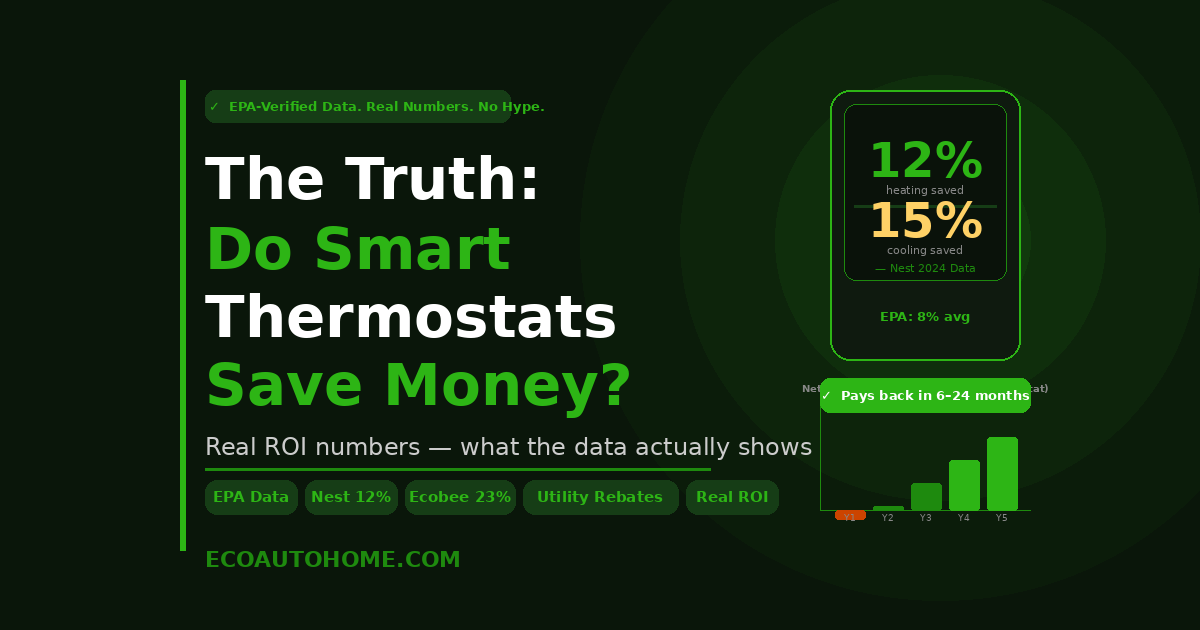
The US Environmental Protection Agency certifies smart thermostats under its Energy Star programme and publishes independent estimates of real-world savings. The EPA’s verified figure is 8% average savings on heating and cooling costs for Energy Star certified smart thermostats. That’s the independent government number — not a manufacturer claim, not a marketing headline.
Google has published its own data from utility bill comparisons before and after Nest thermostat installation. In a 2024 update to its ongoing savings assessment, Google found that Nest thermostats save an average of 12% on heating bills and 15% on cooling bills. Those figures are corroborated by independent utility trials — including studies by Indiana-based Vectren and the Energy Trust of Oregon — which verified Nest’s results separately from the manufacturer’s own analysis.
Ecobee claims up to 23% savings on heating and cooling compared to a constant 72°F hold. That number comes from an internal analysis conducted in 2021 and cited consistently in their product documentation. It’s higher than the EPA’s independent average because it represents savings against a non-programmable baseline — a thermostat that never adjusts at all — rather than against a programmable thermostat or a household that already manages temperature manually.
A peer-reviewed study published in 2025 reviewing 57 research articles using ecobee’s Donate Your Data dataset — drawn from over 200,000 participating customers — confirmed that smart thermostats are a proven energy efficiency technology, with consistent results across HVAC system types and climate zones in US residential buildings.
So which number is right? They all are — for different baselines. The EPA’s 8% is the most conservative and most independently verified. Google’s 12 to 15% is manufacturer-reported but corroborated by utility trials. Ecobee’s 23% assumes you’re replacing a thermostat you never adjusted. In practice, most homeowners replacing a standard non-smart thermostat and using the smart device’s features properly can expect 10 to 15% savings on their HVAC costs.
What That Actually Means in Dollars
Percentages are useful context. Dollar amounts are what actually matter when you’re deciding whether to spend $60 or $280 on a thermostat.
HVAC — heating and cooling — accounts for approximately 46% of the average US home’s total electricity consumption, according to EIA data. The average US residential electricity bill reached $163 per month in April 2026. That puts the average annual household energy spend at roughly $1,956.
If HVAC represents 46% of that, the average home spends around $900 per year on heating and cooling. A 10% reduction on that specific portion saves $90 per year. A 15% reduction saves $135 per year. Ecobee’s claimed 23% would save around $207 per year from that baseline — though that figure assumes full use of the device’s features against a non-programmable starting point.
The EPA’s own savings estimate for Energy Star certified smart thermostats lands in the $50 to $145 per year range depending on usage, climate zone, local utility rates, and what thermostat was replaced. The US Department of Energy cites a similar range of $50 to $145 annually for typical household applications.
Those are not life-changing numbers on their own. But context matters here. Home energy upgrades have widely varying payback periods. New windows typically cost $300 to $800 per window and may take 20 to 30 years to pay back in energy savings. Attic insulation costs $1,500 to $3,000 installed and pays back in 5 to 10 years. A smart thermostat costs $60 to $280 and pays back its cost within 6 months to 2.5 years — making it one of the fastest-returning energy upgrades available to homeowners or renters.
The Honest ROI Breakdown by Thermostat Price
Here’s the payback math laid out clearly, using the EPA’s conservative $50 to $145 annual savings range as the baseline.
Budget tier — Amazon Smart Thermostat (~$62): At $50 annual savings: payback in 15 months. At $100 annual savings: payback in 7 months. This is genuinely compelling value. The EPA’s baseline savings estimate alone covers the cost within the first year for most households, and any savings above that floor is pure return. The Amazon Smart Thermostat is Energy Star certified, includes a C-wire adapter, and integrates fully with Alexa. For a straightforward Alexa household with a standard HVAC system, this is the fastest payback available in the smart thermostat category.
Mid-range — Ecobee SmartThermostat Essential (~$150 after typical utility rebates): At $100 annual savings: payback in 18 months. At $150 annual savings: payback in 12 months. Utility rebates of $50 to $100 are widely available for ecobee thermostats through hundreds of US utility providers — check ecobee.com/rebates with your ZIP code before buying. With a $75 rebate, the effective cost drops to around $75, and payback at $100 savings becomes under 9 months. The room sensor capability and Apple HomeKit support add value beyond pure energy savings.
Premium tier — Google Nest Learning Thermostat 4th Gen (~$280) or Ecobee Premium (~$280): At $130 annual savings: payback in approximately 2 years without rebates. With a $100 rebate: payback under 18 months. Utility demand response programs — like Google’s Rush Hour Rewards — can add an additional $40 to $100 per year in bill credits for participating in grid management events, which accelerates payback further. Google confirms that Nest thermostats collectively helped customers save over 113 billion kWh of energy between 2011 and 2022.
The pattern is clear: every price tier pays back within a reasonable timeframe. The budget option pays back fastest. The premium options pay back more slowly but deliver more savings over a 5 to 10 year horizon due to features like learning algorithms, occupancy sensing, and room sensors.
The Features That Actually Drive Savings — And the Ones That Don’t
This is the part most guides skip. Not all smart thermostat features contribute equally to your energy savings, and understanding which ones drive real results helps you choose the right device and set it up correctly.
Scheduling — The Foundation
The US Department of Energy states that adjusting your thermostat 7 to 10 degrees for 8 hours per day — lower in winter when you’re sleeping or away, higher in summer when you’re sleeping or away — saves up to 10% on heating and cooling annually. Smart thermostats do this automatically, consistently, every single day, without you having to remember.
This is the single biggest driver of savings. A smart thermostat with a well-configured schedule outperforms a smart thermostat with no schedule — regardless of how sophisticated the other features are.
Geofencing — The Savings You’d Otherwise Miss
Geofencing tracks your phone’s location and switches the thermostat to away mode when you leave home. It starts warming or cooling before you return so the house is comfortable when you arrive. The practical value isn’t the geofencing itself — it’s catching all the days when you leave unexpectedly, stay away longer than planned, or simply forget to adjust the thermostat before you go.
Every hour your HVAC runs unnecessarily in an empty house is wasted money. Geofencing eliminates that waste automatically. Based on real-world usage data, geofencing adds meaningfully to the savings that fixed scheduling alone delivers — particularly for households with irregular routines.
Learning Algorithms — Useful But Overrated in Marketing
The learning feature — where the thermostat observes your behaviour over one to two weeks and builds a schedule automatically — is genuinely useful for households that never got around to programming a schedule manually. If you take 20 minutes to program a proper schedule yourself, the learning algorithm adds relatively little incremental value beyond that.
Where learning algorithms provide real extra benefit is in refinement over time — adapting to seasonal pattern shifts, detecting changes in your routine, and integrating weather forecast data to anticipate heating and cooling needs before they arise.
Occupancy Sensing — The Feature Worth Paying For
Room sensors — included with the Ecobee Enhanced and available separately for other models — measure temperature and occupancy in rooms beyond where the thermostat is installed. This matters because most thermostats are installed in hallways or common areas, not where people actually spend their time.
If your thermostat is in the hallway and reads 70°F while your living room is 74°F and your bedroom is 68°F, the thermostat is making decisions based on irrelevant data. Room sensors that report actual occupied-room temperatures to the thermostat’s decision-making logic drive meaningfully better outcomes — particularly in multi-room homes where temperature distribution is uneven.
Energy Reports — The Awareness Driver
Most smart thermostats generate monthly energy usage reports showing your consumption, runtime hours, and comparison to similar homes in your area. These reports don’t save energy directly, but they change behaviour. Seeing that your HVAC ran 312 hours last month — or that your home used 23% more energy than comparable homes nearby — motivates real adjustments. Awareness consistently precedes action.
When Smart Thermostats Save Less Than Advertised
This is the honest part that manufacturers don’t put in their marketing material — and it genuinely matters for setting accurate expectations.
If you already have good thermostat habits, the savings from a smart thermostat will be lower than the published averages. Someone who manually adjusts their thermostat every morning, every evening, and before every trip away is already capturing most of the savings that automation provides. The smart thermostat adds convenience and catches the times they forget — but not the dramatic percentage reductions seen in households replacing a thermostat that’s been set at a constant temperature for years.
If your home has poor insulation or significant air leaks, no thermostat — smart or otherwise — can compensate for heat escaping through walls, ceilings, and windows faster than the HVAC system can replace it. Thermostat savings are a function of reduced HVAC runtime. If your home is losing conditioned air constantly, you need insulation and air sealing more urgently than you need a smart thermostat.
If you live in a mild climate where heating and cooling costs are minimal — Pacific Northwest, parts of Northern California, some mountain regions — the absolute dollar savings from a smart thermostat are proportionally smaller because your HVAC costs are already low. A 12% saving on a $40 monthly HVAC bill is $4.80 per month. That’s still positive, but the payback period extends significantly.
If your HVAC system is old and inefficient, the thermostat can optimise when the system runs but cannot change how much energy it uses when it does run. An HVAC system operating at 60% efficiency will always cost more to run than a modern high-efficiency system, regardless of scheduling. In this situation, HVAC replacement may offer a larger financial return than thermostat optimisation.
Utility Rebates: The Savings Nobody Mentions Enough
Here’s the real multiplier that most smart thermostat articles skip over — and it’s one of the most impactful factors in your actual ROI.
Hundreds of US utility companies offer rebates on smart thermostat purchases ranging from $25 to $100 per device. Some states offer more. Massachusetts through Mass Save offers up to $100 rebate, and qualifying homeowners can receive a free thermostat during a home energy assessment. Pennsylvania’s FirstEnergy offers $50 rebates with instant discounts at Lowe’s. New Jersey PSE&G offers up to $100. The DSIRE database at dsireusa.org lists available incentives by state and utility for the most comprehensive lookup.
These rebates apply to most Energy Star certified smart thermostats including Nest, ecobee, and Honeywell models. They apply to renters as well as homeowners in most programmes — with landlord approval where a permanent installation is involved.
On top of purchase rebates, demand response programmes like Google’s Rush Hour Rewards and ecobee’s Community Energy Savings pay you ongoing bill credits — typically $40 to $100 per year — for allowing your thermostat to make small adjustments during peak grid demand events. You maintain full override control at all times. These programmes are essentially free money for minimal inconvenience.
If your utility offers a $75 rebate and you participate in a demand response programme earning $50 per year in credits, the effective cost of a $150 ecobee Essential drops to $75 upfront, and the ongoing annual benefit includes both energy savings and demand response credits — potentially making the total payback under six months.
Check your utility provider’s website before purchasing any smart thermostat. Rebates are often first-come, first-served and have deadlines — typically within 60 to 90 days of purchase. Setting a reminder to submit immediately after installation is the single most commonly missed step in the smart thermostat upgrade process.
For a detailed comparison of the top two smart thermostat brands on the market — covering energy savings, ecosystem compatibility, and which system is right for different homes — our guide on Ecobee vs Nest Smart Thermostat goes deep on every dimension that matters.
FAQ
How much do smart thermostats actually save per year?
The EPA’s independently verified figure for Energy Star certified smart thermostats is an average of 8% on heating and cooling costs — translating to roughly $50 to $145 per year for the average US household depending on climate, HVAC efficiency, and how actively the thermostat’s features are used. Google’s 2024 data from real-world Nest installations shows 12% heating savings and 15% cooling savings. Ecobee reports up to 23% savings, measured against a non-programmable baseline. For a typical home spending $900 annually on HVAC, expect $90 to $135 per year in realistic savings with proper device setup.
How long does a smart thermostat take to pay for itself?
It depends on the device cost and your savings. A $62 Amazon Smart Thermostat at the EPA’s conservative $50 annual savings estimate pays back in 15 months. At $100 savings it’s 7 months. A $280 Nest or Ecobee Premium at $130 annual savings pays back in roughly 2 years without rebates — or under 18 months with a $100 utility rebate. After payback, all future savings are pure return. Over a 10-year thermostat lifespan, even conservative savings figures represent a significant positive return on a modest investment.
Do smart thermostats save money if I’m already careful about temperature?
Less so — and that’s the honest answer. The biggest savings come from automating what you’d otherwise forget. If you’re already adjusting your thermostat consistently when you leave, sleep, and return home, a smart thermostat’s primary financial benefit shifts from large energy savings to convenience, peace of mind, and remote access. You’ll still save something — particularly from geofencing catching unexpected schedule changes — but the gap between your current habits and what a smart thermostat delivers will be smaller than for someone replacing a thermostat set at a constant 72°F year-round.
Are the manufacturer savings claims accurate?
The most credible numbers come from independent sources. The EPA’s 8% average figure is the most conservative and most independently verified. Google’s 12 to 15% figures are manufacturer-reported but corroborated by independent utility studies in Indiana and Oregon. Ecobee’s 23% claim compares against a constant-hold baseline rather than a managed programmable thermostat, which inflates the figure for anyone already managing their temperature actively. All figures represent averages across large populations — your actual savings will vary based on climate, HVAC efficiency, home insulation, and how consistently you use the device’s features.
Do smart thermostats qualify for utility rebates?
Yes — and this is underutilised. Hundreds of US utility companies offer $25 to $100 rebates on Energy Star certified smart thermostats. These apply to renters as well as homeowners in most programmes. Demand response programmes like Google Rush Hour Rewards and ecobee Community Energy Savings add $40 to $100 in annual bill credits for allowing small temperature adjustments during peak grid demand events. Always check your utility provider’s website or enter your ZIP code at ecobee.com/rebates or the DSIRE database at dsireusa.org before purchasing — rebates often have 60 to 90 day submission deadlines from the purchase date.
The Verdict
Do smart thermostats save money? Yes — reliably, measurably, and quickly relative to almost every other home energy upgrade available.
The EPA’s conservative independent estimate is $50 to $145 per year. Google’s independently verified data shows 12 to 15% savings on HVAC costs. The payback period ranges from six months for budget models in the right home to two and a half years for premium models without rebates — and much faster with utility rebates and demand response credits factored in.
What smart thermostats don’t do is compensate for a poorly insulated home, fix an inefficient HVAC system, or deliver dramatic savings to someone who was already managing their temperature carefully. They automate the habits that most people do inconsistently — and that automation, compounded over days, months, and years, adds up to real money.
The honest conclusion: for most households replacing a standard non-programmable or basic programmable thermostat, a smart thermostat pays for itself within one to two years and then generates consistent savings for the remaining eight or more years of its lifespan. That’s a better return than almost any other home upgrade at any price point.
For more honest smart home guides built around real data and real homes, explore EcoAutoHome.



One Comment