You’ve spent time researching smart thermostats. You’ve looked at Nest, Ecobee, Honeywell. You find one you like, read the installation requirements, and then see those words that end the search: requires a 24V HVAC system.
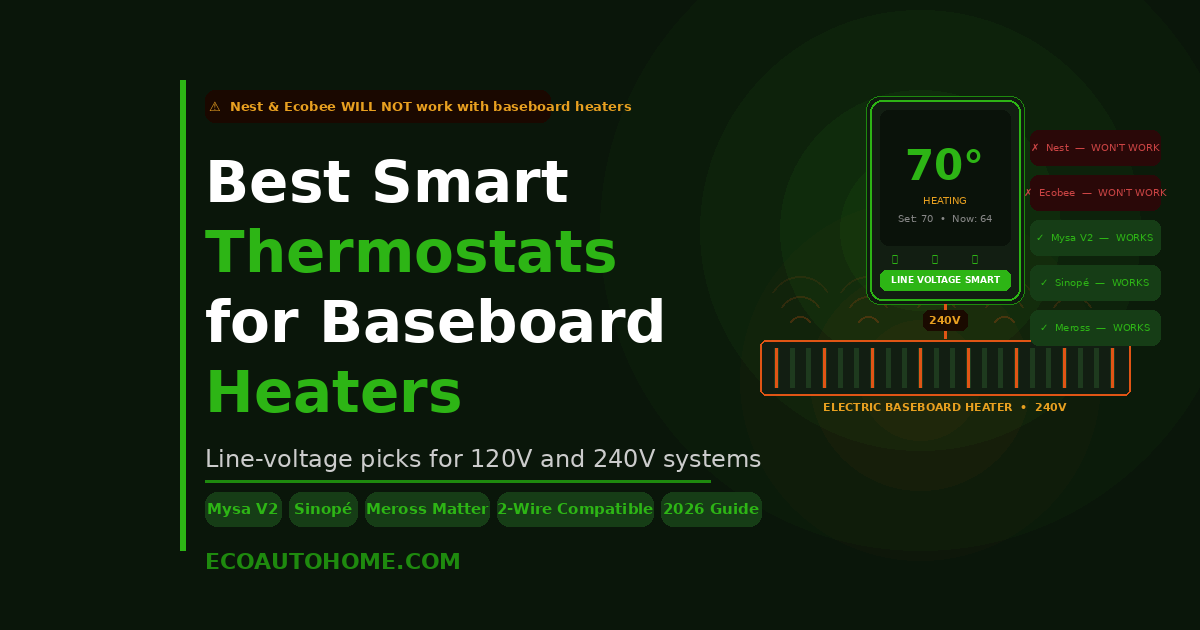
If your home heats with electric baseboard heaters, that’s a wall you’ve probably hit before. The entire mainstream smart thermostat category — Nest, Ecobee, every Honeywell T-series — is engineered for low-voltage central HVAC systems. Connecting any of them to a 120V or 240V baseboard heater is not just incompatible. It is genuinely dangerous.
The good news is that a dedicated category of line-voltage smart thermostats exists specifically for baseboard heating — and in 2026, the options are genuinely excellent. They offer app control, scheduling, geofencing, energy monitoring, and voice assistant integration — everything you’d expect from a premium smart thermostat — engineered to handle the high-voltage reality of electric baseboard heat.
This guide covers the best line-voltage smart thermostats available in 2026, explains the critical wiring differences you need to understand before buying anything, and tells you exactly which option fits your situation.
The Critical Difference: Line Voltage vs. Low Voltage
This is not a minor technical distinction. Getting it wrong is a safety hazard.
Standard smart thermostats like Nest and Ecobee operate on a 24V AC control signal. They don’t directly switch your heating system on and off — they send a low-voltage signal to a furnace, heat pump, or air handler that does the actual switching. The thermostat itself draws minimal power through a dedicated C-wire.
Electric baseboard heaters are completely different. They run directly on your home’s main electrical supply — either 120V or 240V — with no intermediate control unit. The thermostat sits in the circuit and physically switches the full load of the heater on and off. A 1,500-watt 240V baseboard heater pulls about 6.25 amps continuously. The thermostat handling that circuit needs to be rated to switch that load safely, every time, for years.
A 24V smart thermostat connected to a 240V baseboard circuit won’t just fail to work — it will fail catastrophically. The same applies in reverse. Only a thermostat explicitly rated as a line-voltage device for electric baseboard heating should ever be installed in this application.
What to Check Before You Buy
Spending two minutes confirming these four things before ordering any line-voltage smart thermostat saves you a return trip and a potential installation headache.
Voltage — 120V or 240V? Most North American baseboard heaters run on 240V, but some older installations and smaller heaters use 120V. Check your breaker — a 240V circuit uses a double-pole breaker. Your thermostat must match your circuit voltage. Some models support both — but confirm before ordering.
Wire count at your gang box. Line-voltage smart thermostats require a minimum of three to four wires in most cases. Some older baseboard installations have only two wires — a hot and a load wire — with no neutral. Mysa V2 requires a neutral or second live wire (L2), meaning a minimum of three wires. Sinopé’s TH1123WF/TH1124WF models use power-stealing technology and can operate on two-wire systems. Meross requires four wires. Count your wires before choosing.
Total heater wattage on the circuit. If your gang box controls multiple heaters in parallel — a common configuration in larger rooms — add their wattages together. That total must fall below the thermostat’s maximum load rating. Mysa V2 handles up to 3,800W at 240V. Sinopé’s TH1124WF handles up to 4,000W at 240V. Running a thermostat above its rated maximum load is a fire risk.
Gang box size. Line-voltage thermostats require a standard single-gang electrical box. Some older homes have undersized or non-standard boxes behind the existing thermostat. If the box is crowded with multiple wires from daisy-chained heaters, confirm there’s adequate space before beginning installation.
Why Most Smart Thermostat Guides Skip Baseboard Heating
Here’s something worth understanding about the smart thermostat market: baseboard heating is disproportionately common in certain regions — the northeastern US, Canada, Alaska, rural properties, and older multi-unit buildings — and almost entirely absent from others.
Nest and Ecobee have no reason to engineer line-voltage products because the majority of their US addressable market uses forced-air central HVAC. The result is that homeowners with baseboard heating are systematically underserved by the mainstream smart home market, and often don’t discover the gap until they’ve already bought an incompatible product.
The brands in this guide exist specifically because that gap is real. Mysa was founded in 2016 specifically to address line-voltage smart thermostat needs. Sinopé Technologies is a Quebec-based company with deep expertise in electric heating control products. Meross recently added a dedicated line-voltage model. Each of these exists because the mainstream brands don’t serve this use case.
The Best Line-Voltage Smart Thermostats in 2026
1. Mysa Smart Thermostat for Baseboards V2 — Best Overall
Mysa V2 is the benchmark for line-voltage smart thermostats in 2026 — and it has been the category leader for several years for good reason. It was designed from the ground up for high-voltage baseboard heating, by a team that understood the specific technical challenges of this application before writing a line of code for the app.
The V2 handles 120V to 240V systems with a maximum load of 1,900W at 120V and 3,800W at 240V — sufficient for the large majority of residential baseboard installations. Installation requires a neutral or second live wire (L2), meaning a minimum of three wires in the gang box, plus the two circuit wires (load and line). This requirement makes it incompatible with older two-wire baseboard installations, which is the single most important compatibility check before ordering.
The touchscreen interface is clean and responsive, displaying current temperature in large digits readable from across the room. Adaptive Display Technology adjusts screen brightness based on your sleep and wake patterns — dimming automatically at night without you setting anything. The unit is noticeably compact compared to older line-voltage thermostats, fitting cleanly on a standard single-gang box without the bulky appearance common in this category.
App control via the Mysa app — available on iOS and Android, free, no subscription — delivers full remote temperature control, 7-day scheduling, geofencing that adjusts temperature when you leave and restores comfort before you return, and energy monitoring that tracks consumption and estimates monthly heating costs. The energy monitoring is meaningful in this application because electric baseboard heating is typically the most expensive heating method available. Knowing exactly what each room costs to heat per month, and being able to schedule that heat intelligently, produces real savings — Mysa’s independently cited figure of up to 26% heating savings against an unmanaged baseline aligns with what Energy Star documents for smart thermostat use in electric heating applications.
Smart home integration covers Alexa, Google Home, and Apple HomeKit — the broadest platform support in the line-voltage category. There is no hub required.
The honest limitation: the three-wire minimum requirement. Two-wire baseboard systems are more common than most people realise, particularly in homes built before the 1990s. If your existing thermostat connects to only two wires, you’ll need an electrician to run a third wire or to evaluate your options — or to choose Sinopé instead.
Voltage: 120V / 208V / 240V Max load: 1,900W at 120V / 3,800W at 240V Wiring: Minimum 3 wires required (neutral or L2 needed) Integrations: Alexa, Google Home, Apple HomeKit Price range: Around $90 to $110 per unit
Best for: Most baseboard heating applications where three or more wires are present. The most polished app, the most complete platform support, and the most refined installation experience in the line-voltage category.
2. Sinopé TH1124WF — Best for Two-Wire Systems and Multi-Zone Setups
Sinopé Technologies is a Canadian company with over three decades of experience in electric heating control — and that heritage shows in the TH1124WF. It’s not the flashiest device in the category, but it’s among the most reliable and the most versatile in real-world baseboard heating applications.
The TH1124WF handles up to 4,000W at 240V — the highest load rating of any smart thermostat in this guide, and the right choice for large rooms with multiple heaters on the same circuit. There’s also the TH1123WF at 3,000W for smaller loads — both are nearly identical in features and installation.
The critical differentiator for the Sinopé line is its two-wire power-stealing operation. Unlike Mysa, which requires a neutral wire, Sinopé thermostats power themselves by stealing a tiny trickle of current from the heating circuit — requiring only the two wires already present in most baseboard installations. If your gang box has only two wires and you have no path to running a third, the Sinopé TH1124WF is effectively your only full-featured Wi-Fi smart option for baseboard control in 2026.
One real limitation of power-stealing is worth understanding: in extreme cold when baseboard heaters run continuously for extended periods, the thermostat may struggle to accumulate sufficient charge from a heater that never turns off. This is a documented characteristic of power-stealing thermostats generally. In practice, most residential installations in most climates see this issue rarely or never — but in genuinely extreme cold climates, it’s worth knowing about.
TRIAC switching technology means the Sinopé operates silently. Traditional relay-based thermostats click audibly every time the heater cycles on and off. TRIAC uses semiconductor switching with no moving parts — no clicking, no mechanical wear. In a bedroom or study, this difference matters more than you’d think.
The Neviweb app handles scheduling, geofencing, energy consumption graphs, and multi-zone management. Sinopé’s broader Neviweb ecosystem means all your thermostats — across every room in the house — are managed from a single interface, with the ability to create zones and apply schedules to groups of rooms simultaneously. For a home with five or six baseboard zones, this ecosystem value is significant.
Platform integration covers Alexa, Google Home, and Apple HomeKit. No hub required for the Wi-Fi versions.
Voltage: 240V (TH1124WF) / 240V (TH1123WF) Max load: 4,000W (TH1124WF) / 3,000W (TH1123WF) Wiring: Works with 2-wire systems (power-stealing) — no neutral required Integrations: Alexa, Google Home, Apple HomeKit, Neviweb app Price range: Around $100 to $120 per unit
Best for: Two-wire baseboard installations, large rooms with high-wattage heater loads, and homes with multiple baseboard zones that benefit from Sinopé’s ecosystem management.
3. Meross Smart Thermostat for Electric Baseboard — Best Matter Option
Meross entered the line-voltage smart thermostat category with a dedicated baseboard model that brings Matter certification to a segment that has been slow to adopt the new smart home standard. In 2026, it’s the only Matter-certified line-voltage baseboard thermostat available at a competitive price point.
Matter certification means the Meross baseboard thermostat connects natively to Apple HomeKit, Alexa, Google Home, and Samsung SmartThings without any proprietary hub or bridging device. For households where cross-platform compatibility is a priority — or where the smart home setup needs to remain flexible as ecosystems evolve — this is a meaningful advantage over Mysa and Sinopé, which rely on their own app platforms as the primary interface.
It supports 120V and 240V systems and requires four wires for installation — hot wire, load wire, neutral, and ground. This makes it the most demanding of the three options in terms of wiring requirements, and it means two-wire and three-wire systems are not compatible. The wiring requirement is the primary filter — if your installation has four wires available, the Meross delivers excellent app control, scheduling, geofencing, and energy monitoring at a price that typically runs $10 to $20 less per unit than the Mysa.
Installation takes around 30 minutes for most standard configurations following the Meross app’s guided setup. The physical interface is a responsive touchscreen with clear temperature display. Voice control works through all connected platforms simultaneously — a direct advantage of Matter’s local-first, multi-platform architecture.
Voltage: 120V / 240V Max load: 3,800W at 240V Wiring: 4 wires required (hot, load, neutral, ground) Integrations: Alexa, Google Home, Apple HomeKit, SmartThings (via Matter) Price range: Around $75 to $90 per unit
Best for: Matter-enabled smart homes, Apple HomeKit priority households, and multi-platform setups where single-app ecosystem management across all smart devices is the goal.
4. Sinopé TH1144WF — Best for Energy Monitoring and Color Display
Sinopé’s TH1144WF is a newer model in their line that addresses the one area where the TH1123WF and TH1124WF fall short: energy monitoring and visual appeal. Where those models have a compact information-dense display with small text, the TH1144WF features a colour touchscreen with a cleaner interface and more prominent energy consumption data.
The energy monitoring capability tracks real-time wattage and historical consumption, with Sinopé claiming up to 25% energy savings when schedules and geofencing are actively used. For baseboard heating specifically — where electricity costs are among the highest of any residential heating source — this data is genuinely actionable.
It works on 120V to 240V systems with the same power-stealing technology as the TH1123WF and TH1124WF, meaning it requires no neutral wire and is compatible with two-wire baseboard installations. The load rating handles up to 3,000W at 240V, which covers most residential applications.
Platform integration covers Alexa, Google Home, and Apple HomeKit through the Neviweb app ecosystem.
Voltage: 120V / 240V Max load: 3,000W at 240V Wiring: Works with 2-wire systems (power-stealing) Integrations: Alexa, Google Home, Apple HomeKit, Neviweb app Price range: Around $105 to $125 per unit
Best for: Homeowners who want Sinopé’s two-wire compatibility plus a modern colour display with built-in energy monitoring. The best visual upgrade in the Sinopé line.
5. Mysa Smart Thermostat LITE — Best Budget Line-Voltage Pick
Not every baseboard room needs the full feature set of the Mysa V2 or the Sinopé TH1144WF. The Mysa LITE brings line-voltage smart control to secondary bedrooms, guest rooms, and lower-priority zones at a price point around $20 to $30 lower than the flagship Mysa.
The LITE supports 120V to 240V systems, handles up to 1,900W at 120V and 3,800W at 240V, and requires a minimum of three wires — the same compatibility requirements as the Mysa V2. It connects via 2.4GHz Wi-Fi with no hub, integrates with Alexa, Google Home, and Apple HomeKit, and is controlled through the same Mysa app as the V2.
What the LITE omits compared to the V2 is the Adaptive Display Technology and some of the more refined UI polish of the flagship model. The core functionality — scheduling, geofencing, remote control, energy reports — remains intact. For rooms where the thermostat is used primarily through the app rather than interacted with physically, the LITE delivers everything that matters at a lower cost per zone.
Voltage: 120V / 208V / 240V Max load: 1,900W at 120V / 3,800W at 240V Wiring: Minimum 3 wires required Integrations: Alexa, Google Home, Apple HomeKit Price range: Around $70 to $80 per unit
Best for: Secondary zones, guest rooms, and cost-conscious multi-room installations where per-unit cost matters. Identical app experience to the Mysa V2 at a lower price.
How to Choose the Right One for Your Home
The decision tree is straightforward once you know your wiring situation.
Two-wire system (only hot and load, no neutral)? Sinopé TH1124WF or TH1144WF are your Wi-Fi smart options. Mysa and Meross are not compatible with two-wire systems. The Sinopé’s power-stealing approach is the engineering solution that makes smart control possible without running new wire.
Three or more wires with neutral present? Mysa V2 is the best overall experience — better app, better display, Apple HomeKit native, geofencing, energy monitoring. The Mysa LITE is the budget version with the same core features.
Four wires present and Matter compatibility is a priority? Meross Smart Thermostat for Electric Baseboard. Only Matter-certified option in this category, works natively with every major platform without a proprietary app as the primary interface.
Multiple baseboard zones across the house? Sinopé’s Neviweb ecosystem handles multi-zone management more cleanly than any alternative. All Sinopé thermostats share one app interface, support zone grouping, and allow schedule changes across all rooms simultaneously.
One final safety note: line-voltage thermostat installation involves your home’s main electrical supply — 120V or 240V — not low-voltage control wiring. Always turn off the circuit at the breaker and verify zero voltage with a non-contact tester before touching any wires. If you’re not comfortable working with line-voltage electrical work, hire a licensed electrician. The installation itself is straightforward for experienced DIYers, but the consequences of mistakes are more serious than low-voltage HVAC wiring.
For a broader picture of how smart thermostat technology generates real energy savings — including the EPA and DOE data on annual savings and payback periods — our guide on Do Smart Thermostats Save Money applies directly to baseboard heat contexts, where the savings potential is even higher given the elevated cost of electric resistance heating.
FAQ
Can I use a Nest or Ecobee with electric baseboard heaters?
No — and this is genuinely important to understand before purchasing. Nest, Ecobee, and all mainstream low-voltage smart thermostats operate on 24V control signals. Electric baseboard heaters run on 120V or 240V line voltage. Connecting a 24V thermostat to a line-voltage circuit will damage the thermostat and creates a safety hazard. Only thermostats explicitly rated as line-voltage devices — like those in this guide — should be used with electric baseboard heaters.
What is the difference between 120V and 240V baseboard thermostats?
The voltage determines which circuit and heater type the thermostat is designed to control. Most North American homes use 240V baseboard heaters — these run on double-pole breakers and are more energy-efficient per unit of heat delivered. Some smaller heaters and older installations use 120V. Your thermostat must match your circuit voltage. Check your breaker panel — a double-pole breaker indicates a 240V circuit. Some thermostats, including the Mysa V2 and Meross, support both voltages. Sinopé’s TH1123WF and TH1124WF are rated specifically for 240V.
Do line-voltage smart thermostats require an electrician to install?
Many homeowners install them as DIY projects — the wiring is more straightforward than it appears because there are no multi-wire HVAC configurations to navigate, just the circuit wires already present in your gang box. However, because line-voltage work involves 120V or 240V electrical supply rather than 24V control wiring, the safety stakes are higher. Always turn off the circuit breaker and verify zero voltage before touching any wires. If you’re not comfortable with electrical work at line voltage, hiring a licensed electrician is the right call — a standard thermostat swap typically takes under an hour of labour.
Why is electric baseboard heating more expensive than other heating types?
Electric resistance heating — which includes baseboard heaters — converts electricity into heat at 100% efficiency. No energy is lost in the conversion process itself. However, electricity is significantly more expensive per unit of heat delivered than natural gas in most US regions. The US EIA documents that in cold climates, natural gas heating costs roughly one-third the per-BTU cost of electric resistance heating. This cost differential is precisely why smart scheduling matters so much for baseboard heat — every hour the heater runs unnecessarily is expensive. A well-programmed smart thermostat that heats only when needed can reduce baseboard heating costs meaningfully.
Can one smart thermostat control multiple baseboard heaters?
Yes — multiple heaters can be wired in parallel to a single thermostat, allowing one thermostat to control all the heaters in a room simultaneously. The critical requirement is that the combined wattage of all connected heaters must not exceed the thermostat’s maximum load rating. For example, two 1,000W baseboard heaters wired in parallel to a Mysa V2 at 240V would draw a combined 2,000W — well within its 3,800W maximum. Always calculate the total connected load before wiring multiple heaters to a single thermostat. If the combined wattage approaches or exceeds the thermostat’s limit, the heaters must be split across separate thermostats on separate circuits.
You Don’t Have to Choose Between Smart Heating and Baseboard Heaters
The mainstream smart thermostat market has largely ignored baseboard heating — but the dedicated line-voltage brands have stepped into that gap and built genuinely excellent products.
Mysa V2 is the right starting point for most homes with modern four-wire wiring — the best app, the best display, Apple HomeKit native, and the most complete smart feature set in the category. Sinopé’s TH1124WF solves the problem that Mysa can’t — two-wire systems — and its ecosystem is unmatched for multi-zone homes. Meross brings Matter to the category for the first time at a competitive price.
Pick based on your wiring first, your platform second, and your budget third. Install it on a weekend. Set a schedule that heats rooms only when you’re actually in them. And watch what happens to your electricity bill over the course of a winter.
Electric baseboard heating is expensive to run unchecked. It’s far more manageable when the heat is smart.
For more practical smart home guides covering the full heating and energy spectrum, explore EcoAutoHome.